
Ripples Institutional Stack
How Ripple Is Building the Infrastructure for On-Chain Finance
Table of Contents
Ripple is assembling something far larger than a payments network: an institutional financial stack. Through a series of major acquisitions and the continued development of the XRP Ledger, XRP and RLUSD, the company is assembling an increasingly broad institutional financial infrastructure spanning payments, custody, prime brokerage, treasury management, liquidity and tokenization. Ripple’s Institutional Stack explores that transformation through ten visual plates, each examining a different layer of the emerging system—from Ripple Prime and institutional settlement to tokenized assets and the potential role of XRP as a bridge for global liquidity. The goal is not to predict what must happen next, but to map what is being built today, understand how the pieces fit together, and consider what becomes possible as more of the world’s financial infrastructure moves on-chain.
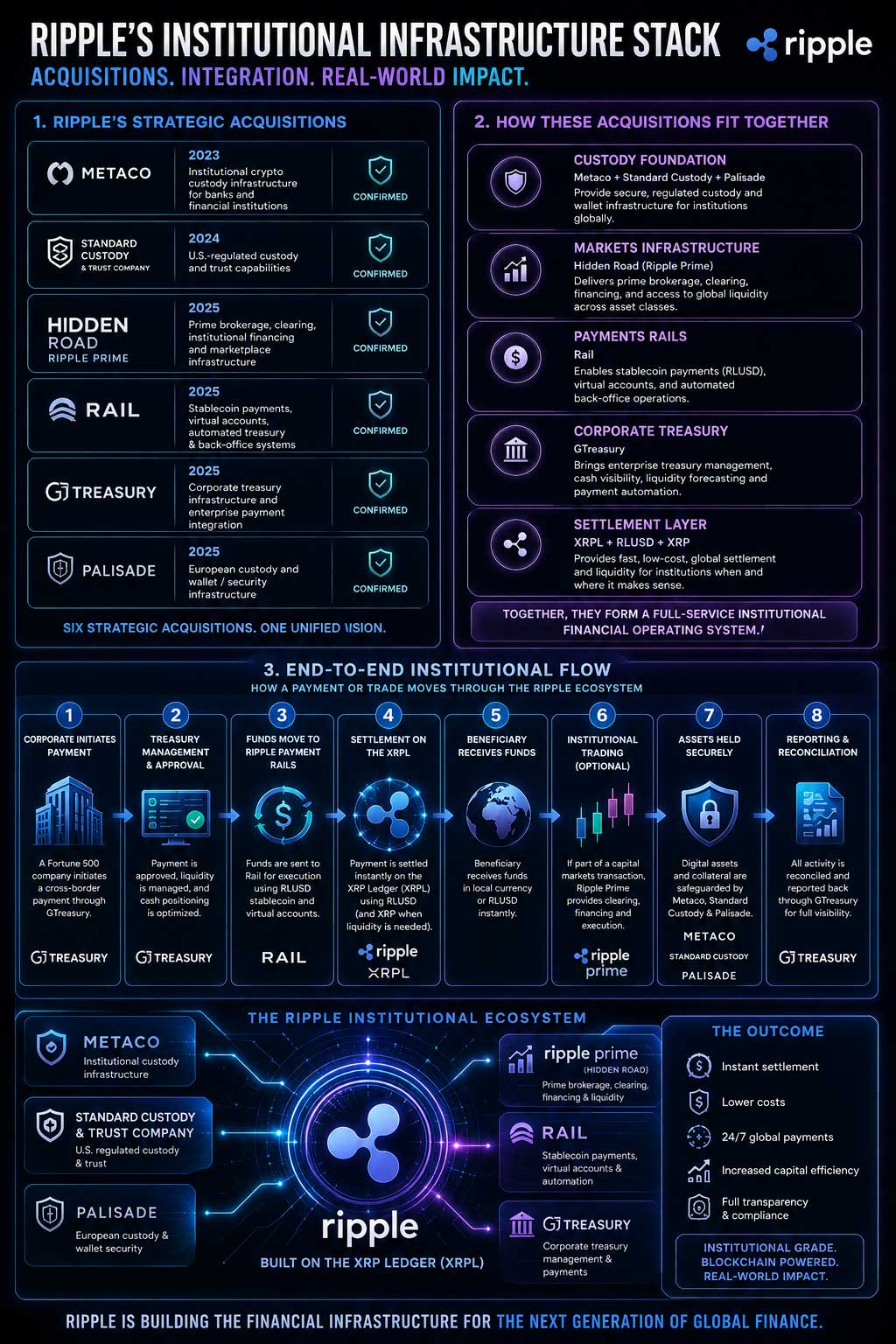
Ripple Institutional Infrastructure
Over several years, Ripple has methodically expanded beyond its original identity as a cross-border payments company. Metaco and Standard Custody strengthened institutional custody; Hidden Road became Ripple Prime, adding prime brokerage, clearing and financing; Rail expanded stablecoin payment infrastructure; GTreasury brought corporate treasury management into the ecosystem; and Palisade added high-speed wallet and custody infrastructure. Ripple now describes this strategy explicitly as building a “one-stop shop for digital asset infrastructure.”
The significance is not any individual acquisition. It is how the pieces fit together. A financial institution entering digital assets needs custody, liquidity, payments, treasury management, compliance, execution and settlement. Ripple has increasingly chosen to own or tightly integrate those capabilities rather than merely connect to them. Its current product suite spans payments, custody, stablecoins and prime brokerage across traditional and digital assets.
That changes the question surrounding Ripple. Instead of asking whether banks will someday “use XRP,” the more useful question becomes: How much institutional financial activity could eventually pass through infrastructure Ripple owns—and where within that infrastructure do XRPL, XRP and RLUSD provide an economic advantage?
“The real story is the sum of these parts: Ripple is building the one-stop infrastructure shop that will power the next era of real-time global finance.”
Ripple
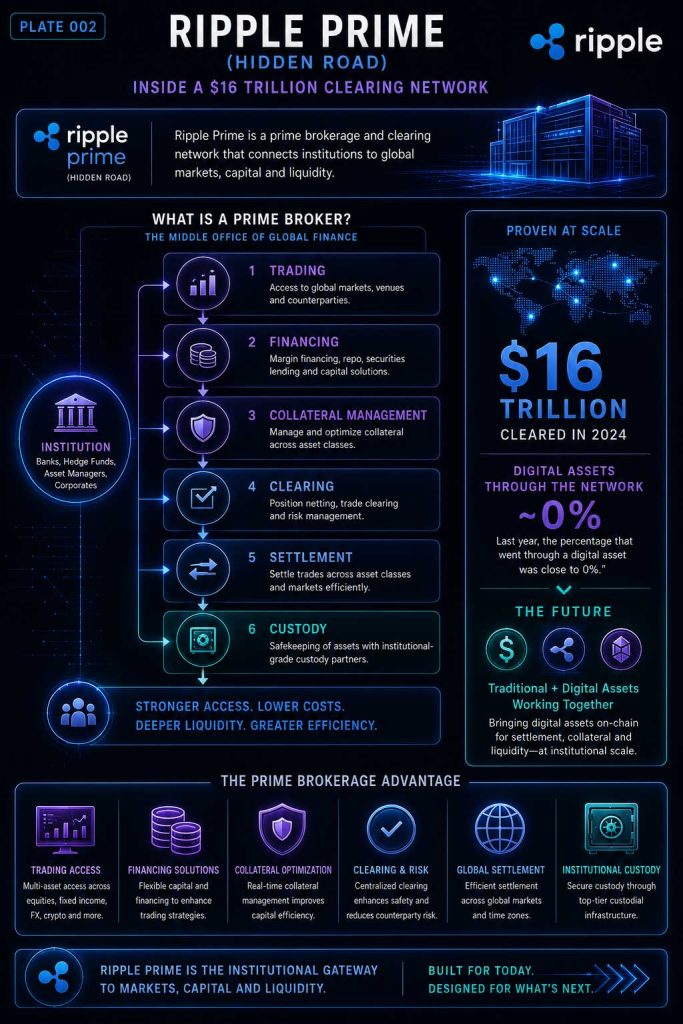
Ripple Prime: Inside the Machine
Ripple’s $1.25 billion acquisition of Hidden Road was qualitatively different from buying another crypto company. Hidden Road was a global multi-asset prime broker operating across foreign exchange, digital assets, derivatives, swaps, fixed income and other markets. When the acquisition closed in October 2025, Hidden Road became Ripple Prime, making Ripple the first crypto company to own and operate a global multi-asset prime broker.
Prime brokerage matters because it sits behind institutional markets. Hedge funds, trading firms and other sophisticated participants need financing, clearing, collateral management, execution and access to multiple markets. Ripple Prime therefore gives Ripple a bridge between the existing financial system and the emerging digital-asset system. Ripple has already expanded the platform to support U.S. institutional OTC spot trading alongside derivatives and other products, including support for XRP and RLUSD.
“Last year, partly through acquisitions, we cleared $16 trillion of payments or clearing on the prime brokerage business. The percentage of that that went through a digital asset was close to 0%.”
Brad Garlinghouse, CNBC, June 26, 2026
That final figure—close to 0%—may be the most important part of the statement. Ripple has acquired infrastructure already processing enormous volumes through traditional financial rails. The opportunity is not that $16 trillion currently flows through XRP or even digital assets; it is that Ripple now controls infrastructure through which some portion of that existing activity could potentially migrate toward digital settlement over time.
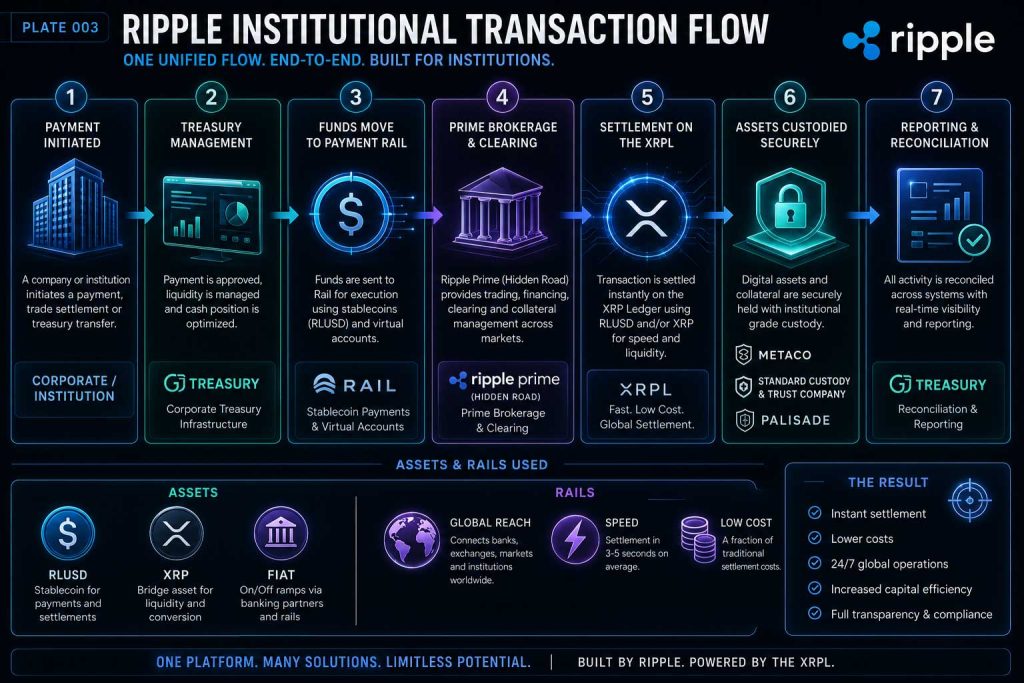
Institutional Transaction Flow
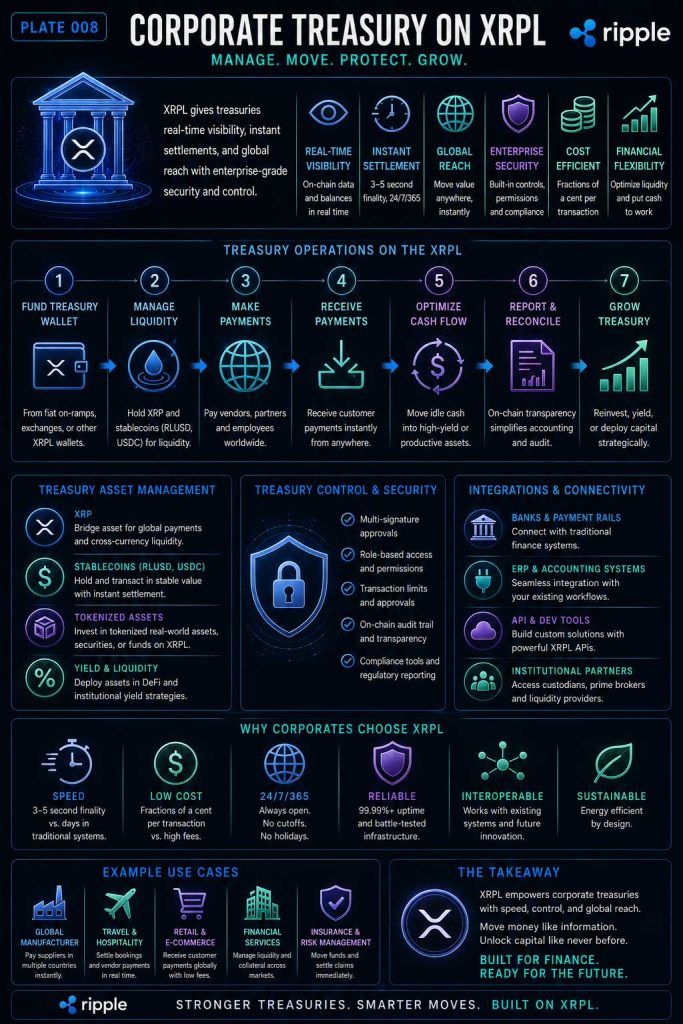
A corporate treasury could originate the need to move capital; Ripple’s payment infrastructure can orchestrate a cross-border transaction; liquidity can involve fiat, stablecoins or XRP depending on the corridor; blockchain provides the settlement infrastructure; and institutional custody protects digital assets at the destination. Ripple Payments itself describes its core functions as bi-directional messaging, optimized settlement and liquidity solutions, serving payment providers, banks and multinational businesses.
But we should be careful not to portray XRP as mandatory for every transaction. Ripple’s architecture is increasingly multi-asset. RLUSD is integrated into Ripple Payments and is designed for cross-border payments, treasury flows and institutional use, while XRP can function as a bridge asset when connecting currencies or liquidity pools makes it advantageous. Ripple’s own current description of XRP identifies payments and liquidity as core utilities and specifically describes XRP as a native bridge asset within XRPL’s liquidity infrastructure.
That distinction actually strengthens the thesis. Ripple does not need every transaction to use XRP. The infrastructure can select the appropriate instrument—fiat, RLUSD, XRP or potentially tokenized assets—while XRP occupies the role for which it was designed: neutral, fast-moving liquidity between otherwise disconnected pools of value.
“Ripple Payments uses blockchain to make cross-border payments faster, more transparent, and widely accessible.”
Ripple
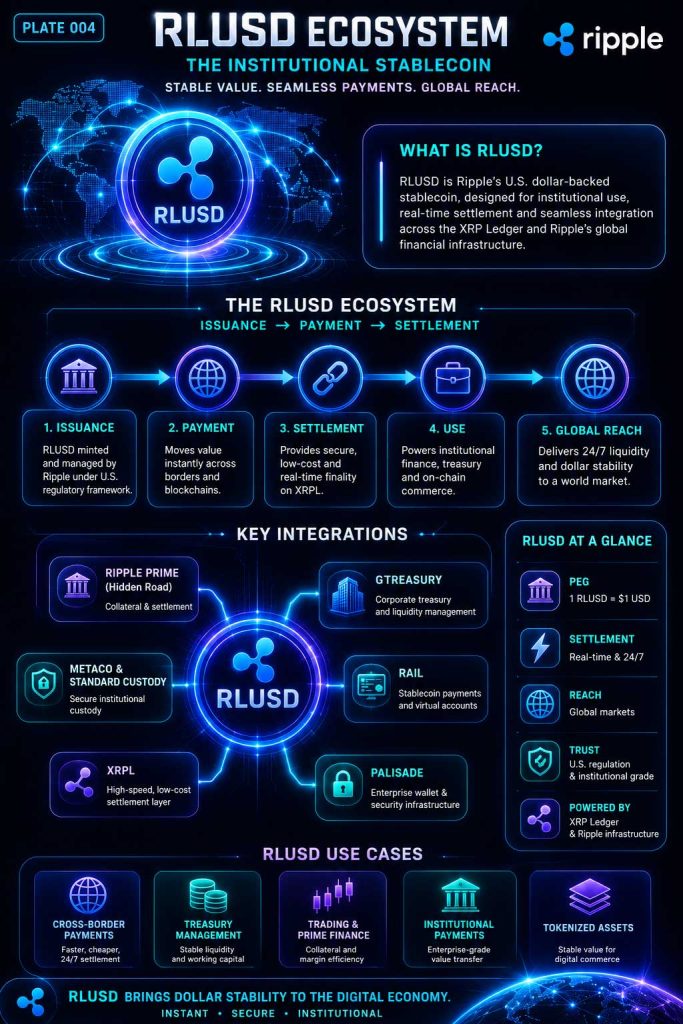
RLUSD: The Institutional Stablecoin
Ripple USD fills a distinctly different role from XRP. RLUSD is designed to maintain a one-dollar value and is backed 1:1 by reserves consisting of cash and cash equivalents, including short-term U.S. Treasuries and other permitted high-quality liquid assets. Ripple positions it specifically for payments, settlement, treasury flows, trading and institutional liquidity—not primarily as a speculative crypto asset.
That distinction is central to understanding Ripple’s emerging architecture. An institution that simply needs to move dollar-denominated value may have no reason to introduce XRP into that particular transaction. RLUSD can remain dollar-denominated from issuance through settlement. XRP becomes more interesting when liquidity needs to cross between different currencies, assets or markets. Rather than competing with each other, the two assets can perform complementary functions: RLUSD provides stable value; XRP can provide neutral bridge liquidity. Ripple itself explicitly describes XRP as the bridge asset and RLUSD as the regulated dollar-backed stablecoin.
The institutional story is also advancing quickly. Ripple reported in June 2026 that RLUSD had reached approximately $1.7 billion in market capitalization, and in July launched Ripple Mint, giving institutions a dedicated interface and API infrastructure to mint, redeem and manage RLUSD at scale.
“RLUSD has rapidly gained traction in financial use cases, serving as a vital bridge for payments, tokenization, and collateral management.”
Ripple
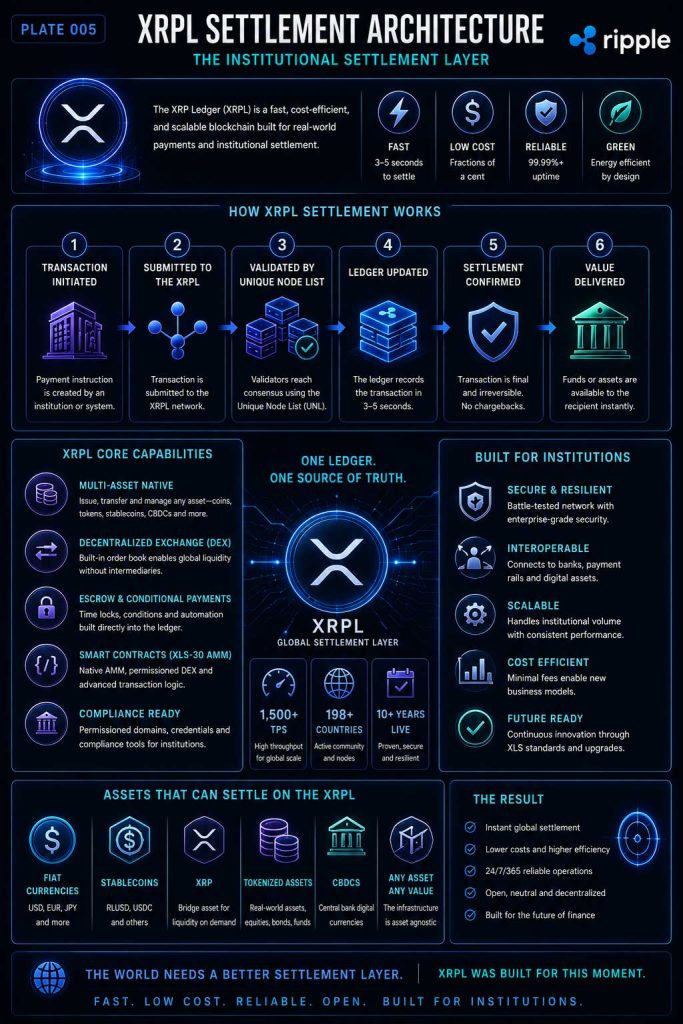
XRPL: The Settlement Layer
The distinction between Ripple, XRP and XRPL matters. Ripple is a company. XRP is a digital asset. The XRP Ledger is an open Layer-1 blockchain. XRPL provides the underlying settlement environment: transactions reach finality in roughly 3–5 seconds, assets can be issued directly on the ledger, and built-in functionality supports payments, exchange, tokenization and increasingly sophisticated institutional financial applications.
What makes this particularly important for institutional finance is that XRPL is evolving beyond simple payments. Ripple now points to capabilities including Multi-Purpose Tokens, Credentials, Permissioned Domains, token escrow, batch transactions and an on-chain lending protocol as components of an institutional financial environment. Ripple says XRPL has operated for more than 12 years and processed more than $1 trillion in value, while positioning it increasingly as infrastructure for regulated tokenized finance.
This suggests a broader way to think about XRPL. The objective isn’t necessarily to put the existing banking system onto a faster payment network. It is potentially to place money, securities, collateral, credit and other financial assets onto a common digital settlement environment where ownership and value can move together. That is a considerably larger proposition than cross-border payments alone.
“XRPL is evolving into a full service financial platform for regulated DeFi, helping institutions send and receive payments, issue credit, trade digital assets and move real-world value onchain.”
Ripple
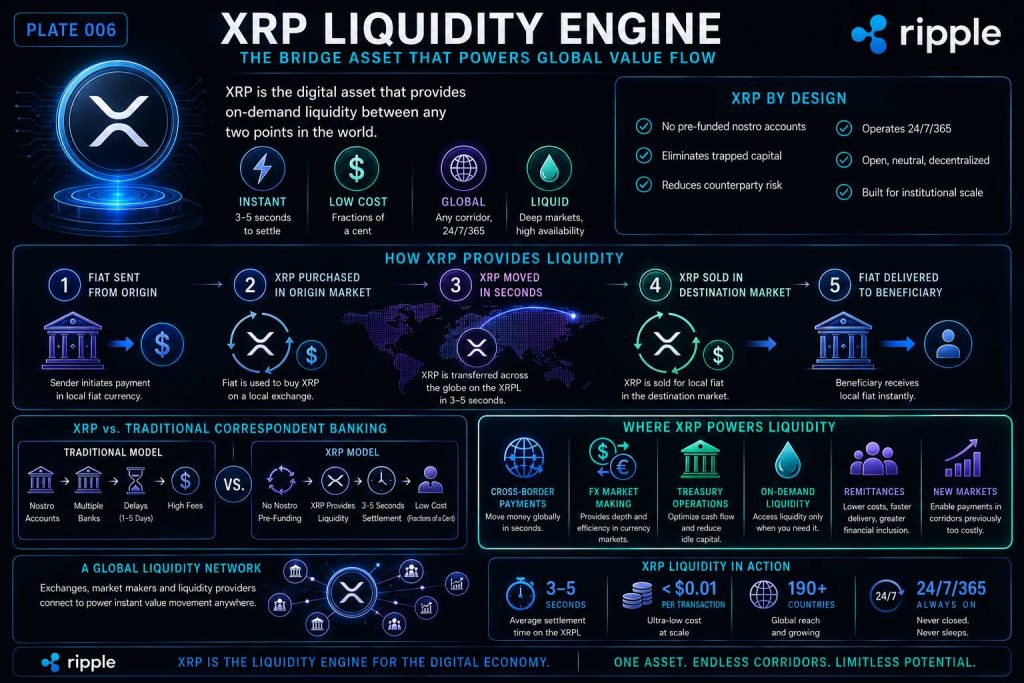
XRP: The Liquidity Engine
This is where the original XRP thesis becomes much clearer. Global finance contains thousands of potential currency and asset combinations. Maintaining direct liquidity between every pair is expensive. Traditionally, institutions solve part of this problem through correspondent banking, reserve currencies, pre-funded accounts and networks of liquidity providers. XRP introduces another possibility: instead of maintaining capital permanently inside every corridor, liquidity can potentially be sourced through a common bridge asset at the moment it is required.
The mechanics are straightforward. Value in Asset A is exchanged for XRP; XRP crosses the ledger in seconds; XRP is exchanged for Asset B. The XRP exposure can therefore exist only during the transaction rather than requiring either institution to hold XRP as a long-term treasury asset. Ripple continues to describe XRP’s utility in payments and liquidity, and its 2026 institutional-DeFi roadmap goes considerably further—positioning XRP as a liquidity and credit component within tokenized financial markets.
This is also where we need to remain disciplined about the thesis. XRP will not automatically be the cheapest route for every transaction. A direct RLUSD-to-dollar route, stablecoin pair, fiat corridor or other liquidity source may sometimes be superior. XRP’s significance therefore depends not simply on transaction volume moving onto XRPL, but on how often XRP becomes the economically preferred intermediary between otherwise disconnected pools of value. That is the metric worth watching as institutional activity grows.
“XRP’s utility is growing across payments, liquidity, and credit markets.”
Ripple
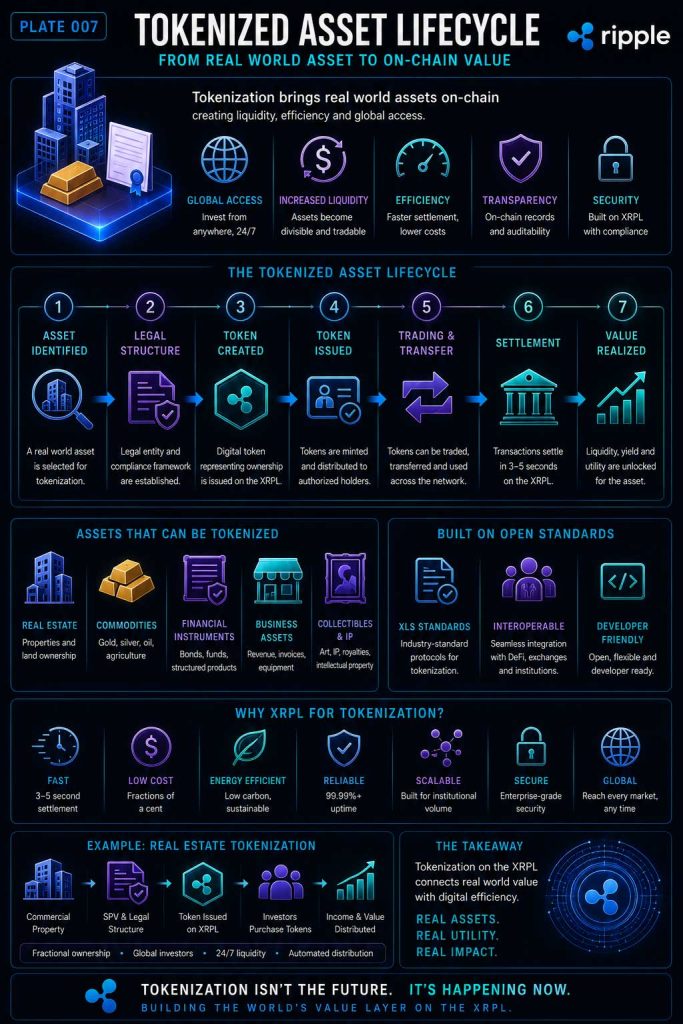
Tokenized Asset Lifecycle
Tokenization converts ownership rights in financial or real-world assets into digital tokens that can move on blockchain infrastructure. That can include Treasuries, bonds, funds, private credit, commodities and real estate. Ripple’s current tokenization platform goes beyond simply creating a token: it incorporates issuance, compliance controls, lifecycle events, transfers and redemption, with XRPL supporting institutional features such as Multi-Purpose Tokens and asset-control functionality.
The deeper significance is that the asset and the settlement infrastructure can begin to converge. Traditional markets often separate issuance, trading, clearing, settlement, custody and recordkeeping across different institutions and databases. Tokenization potentially allows many of those functions to interact with the same digital representation of the asset. Ripple and Boston Consulting Group estimate the tokenized real-world asset market could approach $19 trillion by 2033, but the more important story may be structural: financial assets become programmable, interoperable and potentially available to markets around the clock.
And this is no longer purely theoretical on XRPL. Tokenized Treasuries, money-market products, credit and other real-world assets are already appearing on the ledger. Ripple’s current tokenization materials state that XRPL has processed more than $1 trillion in value and is being developed specifically for regulated tokenized finance.
“Tokenization isn’t a side project. It’s a strategic path.
Ripple
The Global Settlement Network
This is where the individual components begin converging. XRPL already supports payments, issued assets, decentralized exchange functionality and tokenization; institutional additions are expanding that architecture into compliance, credit and lending. Ripple’s February 2026 institutional-DeFi roadmap specifically highlighted Multi-Purpose Tokens, Permissioned Domains, Credentials, Token Escrow and Batch Transactions, alongside development of lending and confidential-transfer capabilities.
The next step is particularly important. Once tokenized assets exist on-chain, simply transferring them isn’t enough to recreate functioning capital markets. They need to become productive: assets must be financeable, usable as collateral and capable of accessing credit and liquidity. Ripple made exactly this argument when discussing the XRPL Lending Protocol in June 2026—the missing layer between tokenizing assets and creating genuine on-chain capital markets.
This is why “global settlement network” should not be interpreted as a prediction that every bank, currency and security will migrate onto XRPL. Multiple ledgers and traditional systems will almost certainly coexist. The more defensible thesis is that XRPL is being developed as one interoperable financial network capable of connecting payments, liquidity, tokenized assets and credit—and competing for a meaningful share of global value settlement.
“Moving an asset onchain is only half the job.”
Ripple
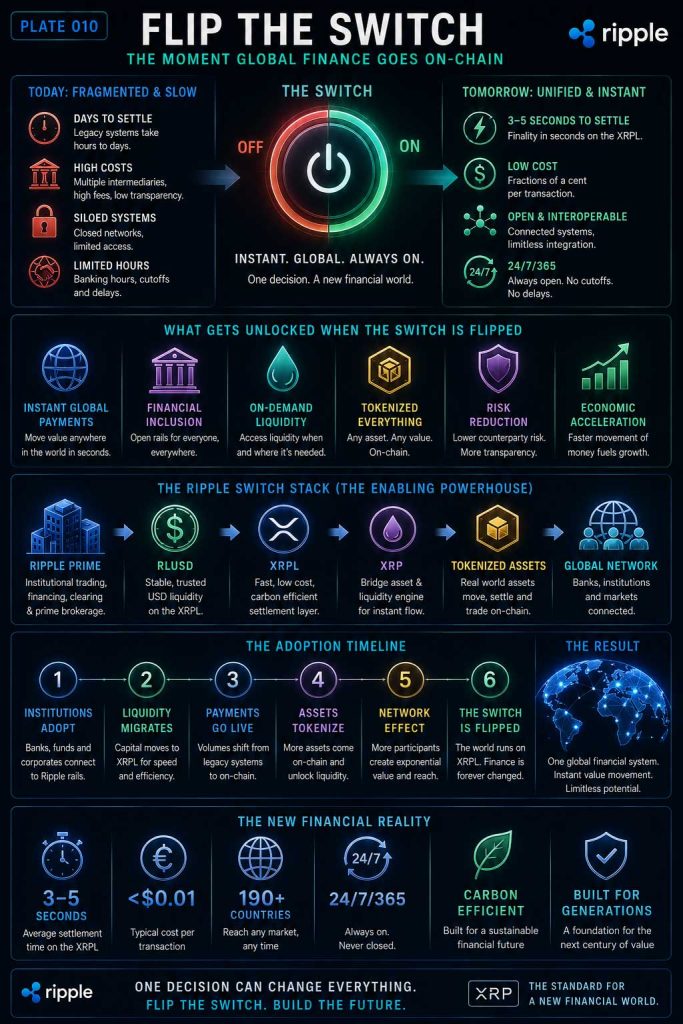
Flip the Switch
“Flip the Switch” works best as a metaphor—not a prediction of a secret activation date. The transformation we’re documenting is already occurring incrementally: stablecoins are being integrated into payments; real-world assets are being tokenized; institutional custody is being built; prime brokerage is connecting traditional and digital markets; corporate treasury is gaining digital-asset capabilities; and credit infrastructure is beginning to move on-chain. Ripple’s own 2026 survey of more than 1,000 global finance leaders found that 72% believe finance leaders must offer a digital-asset solution to remain competitive.
That changes the meaning of adoption. A corporation doesn’t need to become a “crypto company.” A bank doesn’t need to abandon fiat. A fund doesn’t need to hold XRP as a speculative investment. They simply need to encounter a situation where digital infrastructure provides better liquidity, faster settlement, lower friction, better collateral mobility or access to a market that the legacy system handles poorly. Adoption can happen one transaction, one treasury department, one asset class and one corridor at a time.
And that may ultimately be the most compelling interpretation of Ripple’s acquisition strategy. Ripple has assembled payments, custody, stablecoins, prime brokerage, treasury management and tokenization infrastructure while XRPL itself expands into liquidity, compliance and credit. None of this proves that XRP will capture a predetermined percentage of global finance, nor does it justify assuming extraordinary future valuations. But it does establish something much more concrete: the infrastructure required for institutional on-chain finance is being built now, and Ripple has deliberately positioned itself across multiple layers of that transition.
“The foundation for the next generation of blockchain-based financial infrastructure is being built, with XRP as the backbone.”
Ripple
Ripple did not simply spend billions acquiring companies. It acquired capabilities.
Custody.
Payments.
Stablecoins.
Prime brokerage.
Treasury.
Tokenization.
And alongside those businesses sits an open-source ledger designed to settle value, a dollar stablecoin designed to represent stable value, and XRP—a scarce native asset designed to provide liquidity and bridge value where that function is economically useful.
What happens if even a fraction of the world's financial activity begins moving through this infrastructure?