
Table of Contents

A fictionalized investigation begins: public blockchain data, unresolved origins, and the possibility that XRP’s early architecture points toward a future of tokenized value.

Introduction

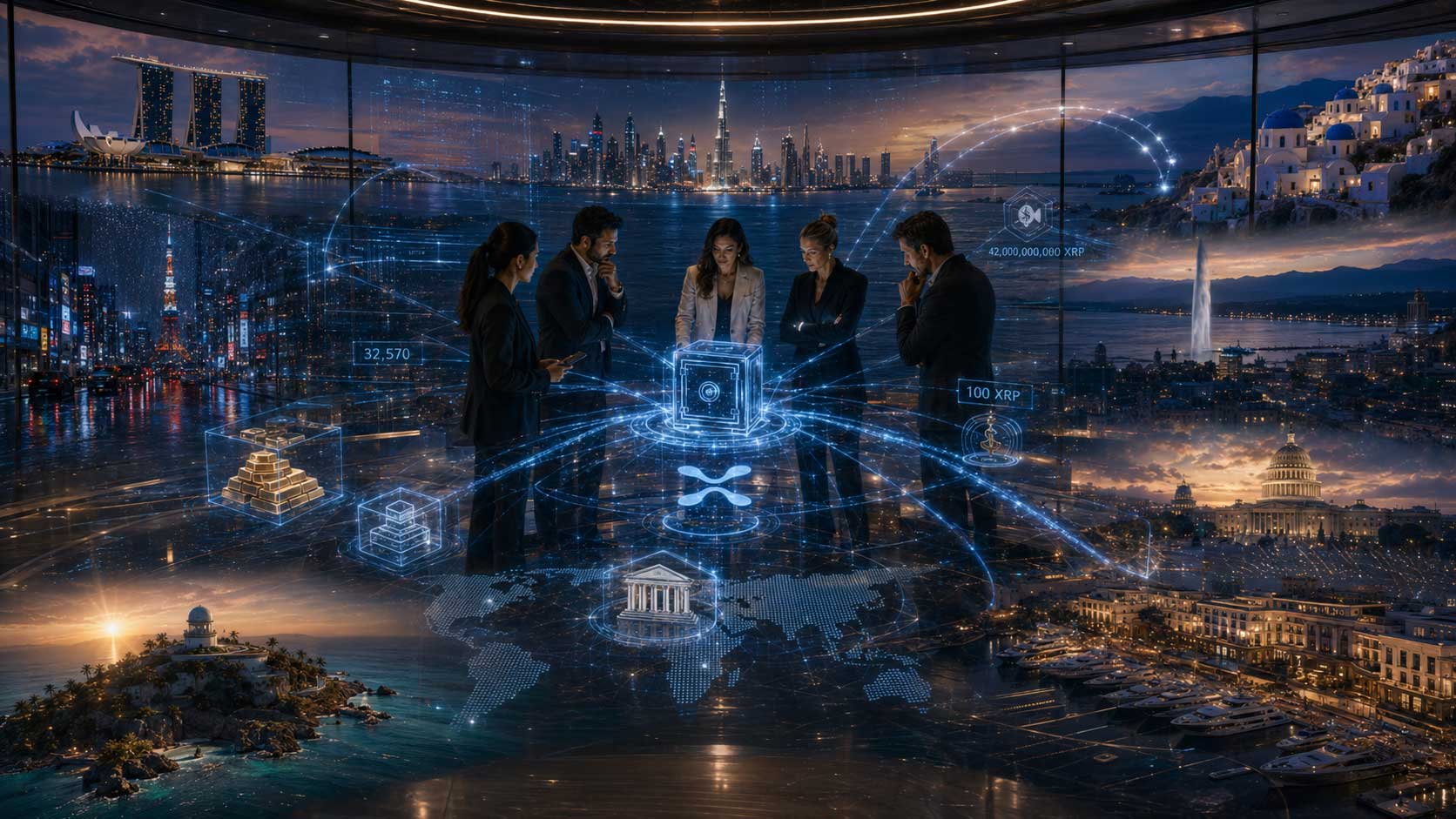
This story is a fictionalized investigation built around real claims, public blockchain data, and unresolved questions from the earliest visible history of the XRP Ledger. The characters are fictional, but the central evidence they examine — missing early ledgers, large early wallet balances, Fort Knox-themed wallet names, major XRP movements, Ripple-linked flows, and later institutional connections — comes from research that deserves careful review rather than blind belief or easy dismissal. The purpose of the story is not to prove that XRP is secretly backed by gold. The stronger question is whether XRP’s early architecture, distribution patterns, and settlement design point toward a larger role in the future tokenization of value: gold, treasuries, stablecoins, commodities, currencies, and global liquidity. What follows is not a verdict. It is a probability map.

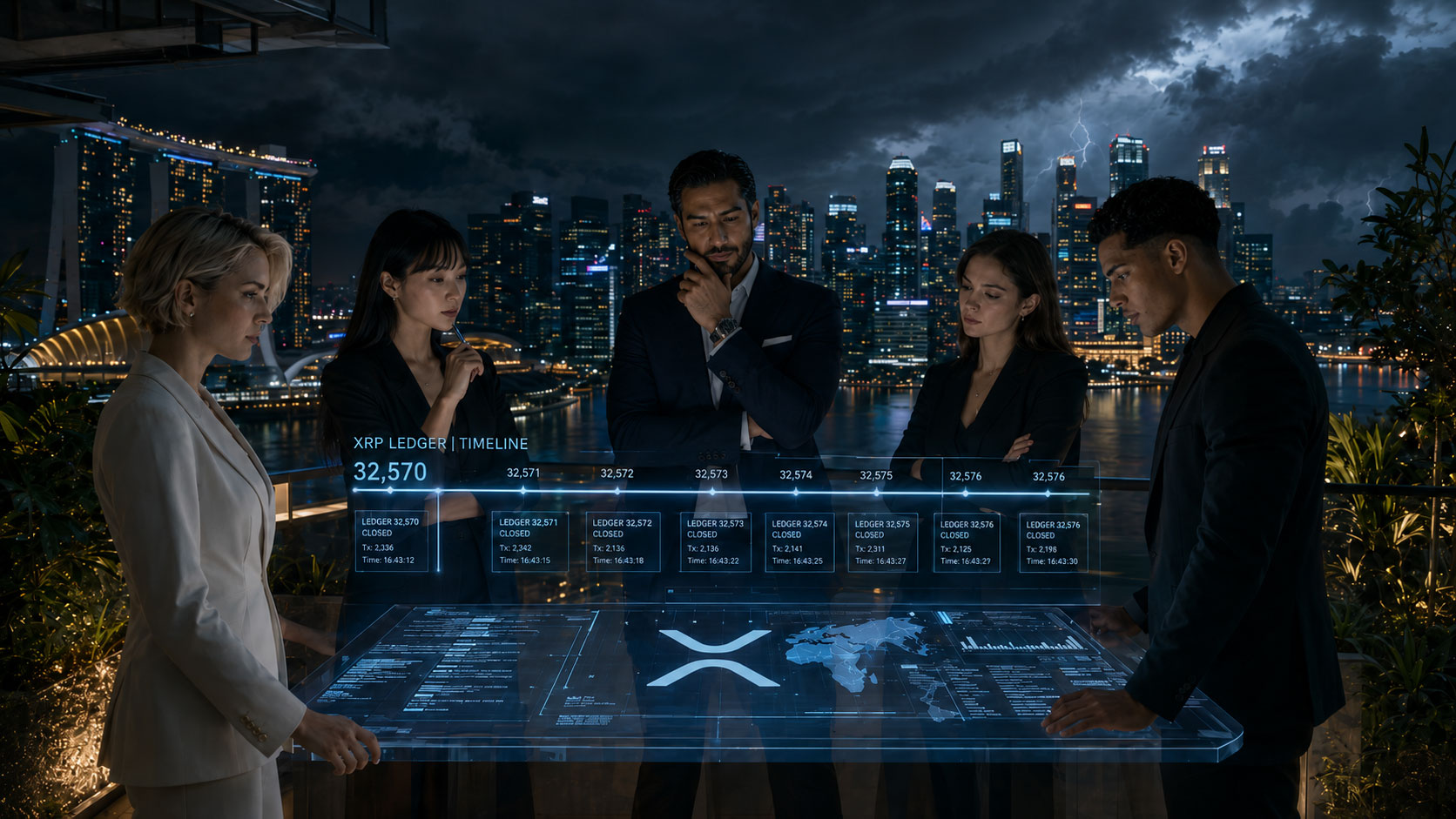
Above Marina Bay, the investigation begins with a missing origin: the XRP Ledger’s first visible marker, 32,570.

Ledger 32,570

The rooftop garden floated above Singapore like a private island in the sky.

Below it, the city shimmered in layers of glass, water, and light. Towers rose from the harbor like polished instruments. The bay reflected the skyline in broken gold and blue, each ripple catching pieces of a world already moving beyond paper money, borders, and the slow machinery of old finance.

Elena had chosen Singapore deliberately. It was not the birthplace of XRP, nor the center of American monetary power, but it understood the future the way few cities did: finance, shipping, sovereign strategy, digital infrastructure, and water, all compressed into one glittering harbor. If the investigation was going to begin with settlement, liquidity, and trust, Singapore was the right place to ask the first question.

Storm clouds gathered over Marina Bay, but no one at the table moved.

Elena Voss stood at the edge of the transparent console, her white jacket catching the cool glow from the holographic display. Across from her, Tariq Al-Mansoor watched in silence. Noa Tanaka had already stopped blinking. Rhea Voss stood with her arms folded, skeptical but alert. Jalen leaned forward, studying the data with the discipline of someone trying not to believe too quickly.

At the center of the table, the XRP Ledger timeline hovered in blue-white light.

It did not begin at one.

It began at 32,570.

Noa expanded the display. A chain of ledger entries stretched outward, each block marked, closed, validated, permanent. Behind ledger 32,570, there was nothing. No ledger one. No ledger two. No genesis trail visible to the public eye. Only a blank wall where the beginning should have been.

“That’s not a gap,” Jalen said quietly. “That’s an origin wound.”

Noa glanced at him. “The official record says the early ledgers were lost during the network’s first days. Technical problems. Resets. The current public history starts here.”

The number brightened.

32,570.

Elena watched the digits as lightning flickered behind the skyline. Every monetary network carried two histories. One appeared in white papers, press releases, and public documentation. The other lived in architecture: allocation, movement, timing, incentives, and the fingerprints of those who built the rails before the world understood what they were for.

Tariq turned toward Noa. “And before this?”

Noa shook her head. “Gone. At least from the surviving public ledger history.”

Rhea exhaled. “That does not prove anything.”

“No,” Elena said. “But it changes how we read everything that survived.”

The team had gathered because of a dossier from Edam Fior, a financial journalist with a habit of finding architecture where others saw noise. His investigation connected XRP’s earliest visible wallets to Fort Knox symbolism, missing ledgers, large distribution movements, and the possibility that XRP’s original purpose had been hiding in plain sight all along: not retail speculation, but settlement infrastructure — a bridge asset designed to move value between currencies, institutions, and eventually tokenized systems. The evidence was not whispered through back channels. It was on-chain, buried in plain sight. Fior’s warning was simple: if the first 32,570 ledgers were missing from the surviving public history, then every surviving name, balance, and movement after that point mattered.

Jalen straightened. “No conclusions before verification.”

“No conclusions,” Elena agreed. “Only probabilities.”

Tariq looked out over the harbor. Container ships moved through the dark water, carrying physical goods through old-world channels while invisible value moved faster through digital rails. Ships, banks, currencies, commodities, reserves — all part of the same ancient problem.

How does value move when trust breaks down?

Noa pulled up another panel. “If the missing ledgers are the blind spot, then the first visible ledgers are our starting point. Whatever came after 32,570 may be the only public evidence left of the earliest XRP architecture.”

Rhea studied the display. “And we are assuming architecture means intention.”

“No,” Elena said. “We are asking whether architecture reveals intention.”

The storm rolled closer. Far below, the city continued its quiet performance of wealth and order, unaware that five people above it were staring at a number that felt less like a beginning than a locked door.

Tariq finally spoke. “Every reserve system has a vault. Every vault has a ledger. Every ledger has a first page.”

Elena looked at the glowing number again.

“Then this one begins with the first page missing.”

The holographic table dimmed around the edges, leaving only the timeline suspended in the night.

32,570.

Not proof. Not myth. A surviving marker. And for Elena Voss, that was enough to begin.

Beginning was not believing. Before the team would follow the Fort Knox signal to its next destination, every claim in Fior’s dossier would have to survive a first round of verification. The number had opened the door. The evidence would decide whether they walked through it.

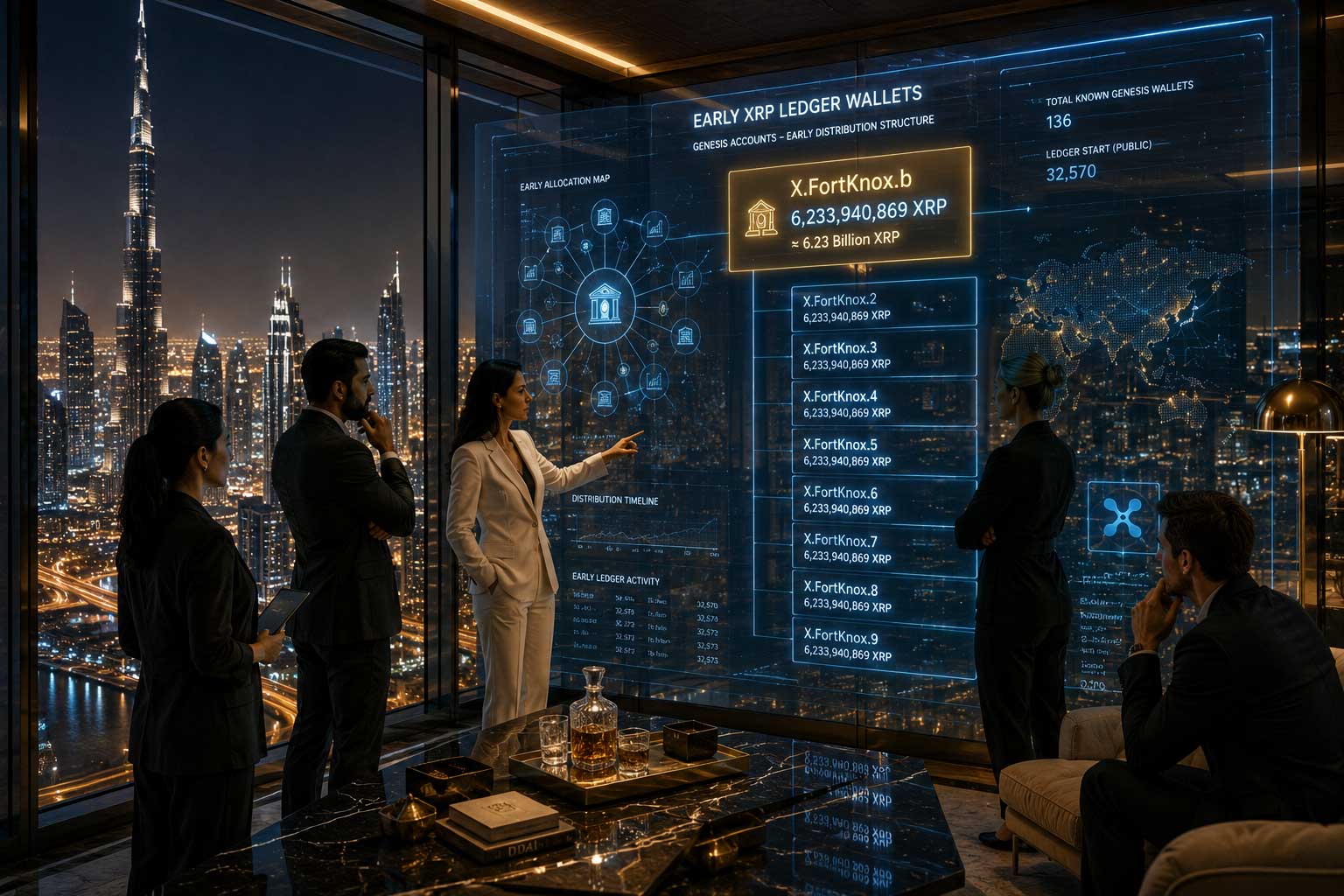
In Dubai, a wallet name becomes a signal: X.FortKnox.b, billions in early XRP, and a pattern too large to dismiss.

The Fort Knox Signal

The next signal appeared two weeks later in Dubai, after twelve days of verification had turned Fior’s dossier from curiosity into a working investigation.

The storm over Singapore had passed into memory, but the number remained with them.

32,570.

It followed Elena Voss through encrypted calls, late-night ledger reviews, and the first attempts to separate Fior’s strongest claims from those still needing proof. By the time the team reconvened in the Gulf, they were no longer chasing a strange story. They were testing a pattern.

By midnight, they stood inside a penthouse suite above Dubai, suspended between glass, desert, and sky.

The Burj Khalifa rose in the distance like a silver blade. Below it, highways flowed in golden veins through the city. Beyond the lights, the desert waited in darkness, ancient and patient, as if reminding them that every empire eventually invented a new way to measure value.

Dubai was chosen for scale. Few cities understood the performance of stored value better: towers, sovereign capital, private wealth, energy money, real estate, and ambition rising out of desert heat. If Singapore was the place to begin with settlement, Dubai was the place to study the language of vaults.

Rhea Voss controlled the wall display. She had stripped away the drama from Fior’s dossier and reduced the evidence to what mattered: early wallet structures, reported genesis balances, wallet labels, and movement paths that could be tested against public ledger records.

“No theories,” she said. “Only names and numbers.”

A list of early XRP wallets appeared across the wall in pale blue light. Most were long strings of characters: cold, machine-like, forgettable.

Then one line expanded.

X.FortKnox.b

The room went quiet.

Noa stepped closer. “Fior’s dossier identifies this wallet as holding more than six billion XRP.”

Tariq’s expression tightened. “Six billion?”

“Reportedly,” Rhea said. “We verify before we trust.”

The name floated there, bright against the glass, while Dubai’s skyline burned behind it.

X.FortKnox.b

Jalen shook his head. “Could be a joke. Could be someone naming wallets after secure places. Fort Knox means vault. It does not automatically mean gold, Treasury, or a reserve system.”

“That is correct,” Elena said.

He looked at her. “You agree?”

“I agree completely. A single name proves almost nothing. But names are not meaningless either, especially near the origin of a monetary network.”

Rhea pulled up the surrounding data. More early labels appeared. More balances. More distribution markers. The first visible layer of the XRP Ledger looked less like a scattered field and more like an allocation map.

Noa highlighted the central claim in Fior’s dossier: early XRP wallet structures included Fort Knox-linked names, and one of the most notable, X.FortKnox.b, allegedly held more than six billion XRP. Fior’s investigation also traced XRP connected to these early structures through multiple wallets, with portions allegedly moving into Ripple-linked flows. The claims were not conclusions yet, but they were testable — and that made them impossible to ignore.

Tariq studied the pattern. “Fort Knox is not merely a vault. It is the American symbol of stored monetary trust.”

“Symbol,” Jalen said. “Not evidence.”

“Agreed,” Tariq replied. “But symbols are often chosen before systems reveal themselves.”

Rhea enlarged the wallet name until it hovered across the entire glass wall.

X.FortKnox.b

The letters washed the room in cold light.

Elena remembered the old architecture of money: gold locked in vaults, paper claims issued against reserves, settlement agreements written behind closed doors, trust made visible through signatures, seals, and guarded buildings. Then she looked at the new architecture: distributed ledgers, validator networks, bridge assets, tokenized claims, liquidity corridors, and settlement without physical movement.

Different tools. Same question.

What gives value the right to move?

Noa opened a second panel. “Fior’s dossier identifies what it calls 136 known genesis wallets.”

Jalen turned from the window. “Can we verify that?”

“Yes,” Noa said. “But not from the dossier alone. We need independent explorer data, early balances, and account naming metadata where available.”

Rhea glanced back at the display. “There is another problem.”

“The name does not appear alone.”

She swiped again.

The glass wall reorganized itself.

X.FortKnox.2
X.FortKnox.3
X.FortKnox.4
X.FortKnox.5
X.FortKnox.6
X.FortKnox.7
X.FortKnox.8
X.FortKnox.9

The room changed.

Not physically. The penthouse remained still. The city still glowed. The desert still waited.

But the investigation had crossed a threshold.

One Fort Knox wallet could be dismissed. A sequence was harder.

Jalen leaned in despite himself. “That could still be naming convention.”

“It probably is,” Elena said.

Tariq looked at her. “The question is: convention for what?”

No one answered.

Below them, Dubai moved like a living circuit: money, oil, real estate, sovereign wealth, tokenization, private capital — all layered together in a city built from ambition and liquidity.

Rhea lowered her voice. “If this is real, then we are not looking at one strange wallet. We are looking at a labeled structure.”

Noa nodded. “And structures imply design.”

Jalen looked at Elena. “Careful.”

“Always.”

They had not found proof that XRP was backed by gold. They had not found proof that Fort Knox meant anything more than a label. But they had found a pattern large enough to demand respect.

And in Elena’s experience, the most dangerous discoveries did not begin as answers.

They began as names no one could explain.

For the next ten days, those names became the center of their work. Not as proof. As coordinates. And when Noa finally overlaid the timestamps, the next destination chose itself.

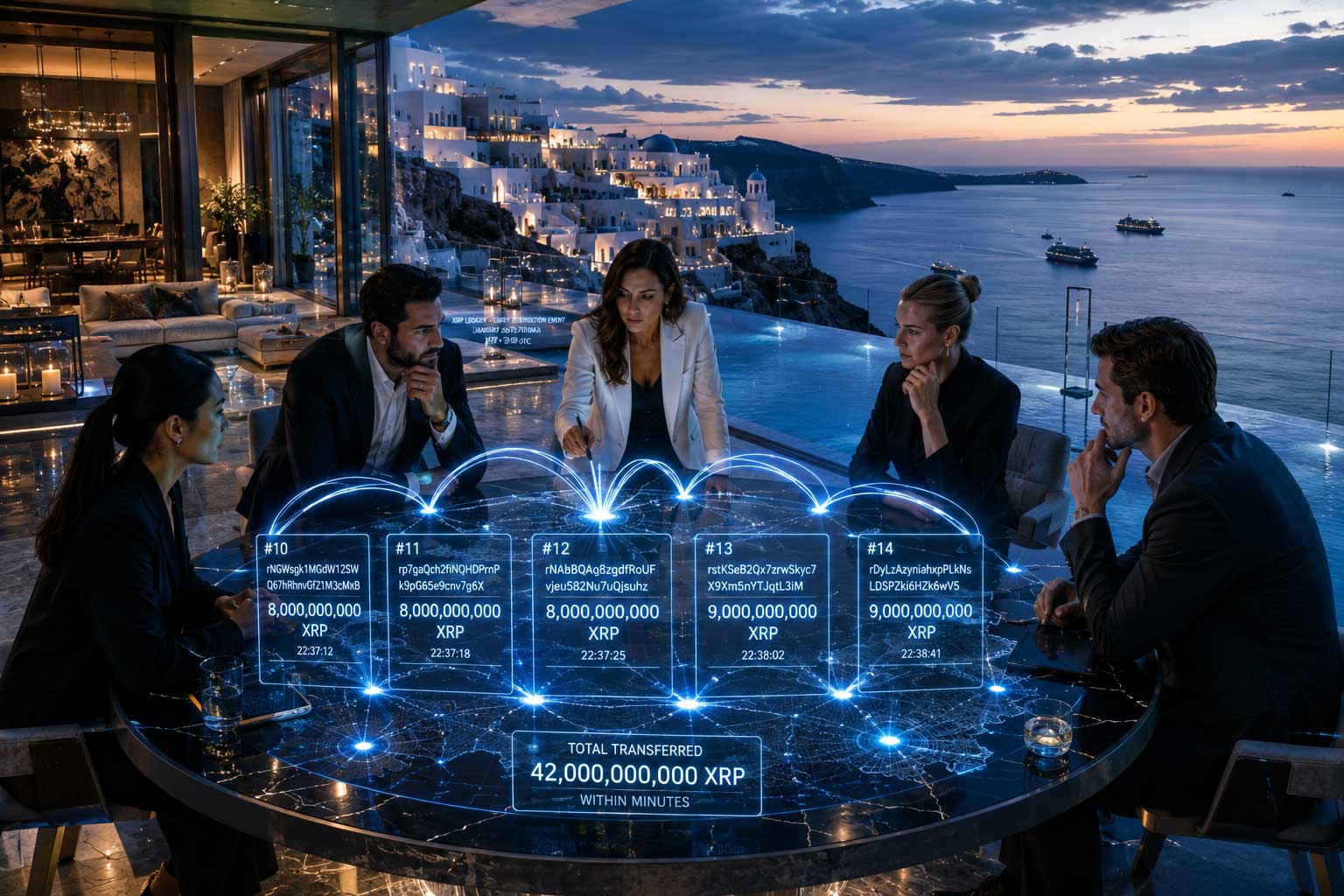
Above the Aegean, the names become motion: five early transfers totaling forty-two billion XRP.

The Forty-Two Billion Movement

Ten days after Dubai, the investigation crossed the Mediterranean. By then, the FortKnox names had become more than labels on a screen. They had become coordinates in a transfer map.

Santorini rose from the Aegean like a white stone memory, its cliffs glowing soft blue beneath the last shadows of night. The villa was built into the caldera rim, half glass, half volcanic rock, with terraces descending toward an infinity pool that seemed to pour directly into the sea.

Elena and the team were in Santorini for a closed settlement-mapping session, where Noa could rebuild Fior’s transfer sequence without interruption. The caldera made the metaphor unavoidable. From above, every ferry, wake, and current left a trace across the water. That was what they needed now: not another label to interpret, not another symbol to debate, but movement they could follow.

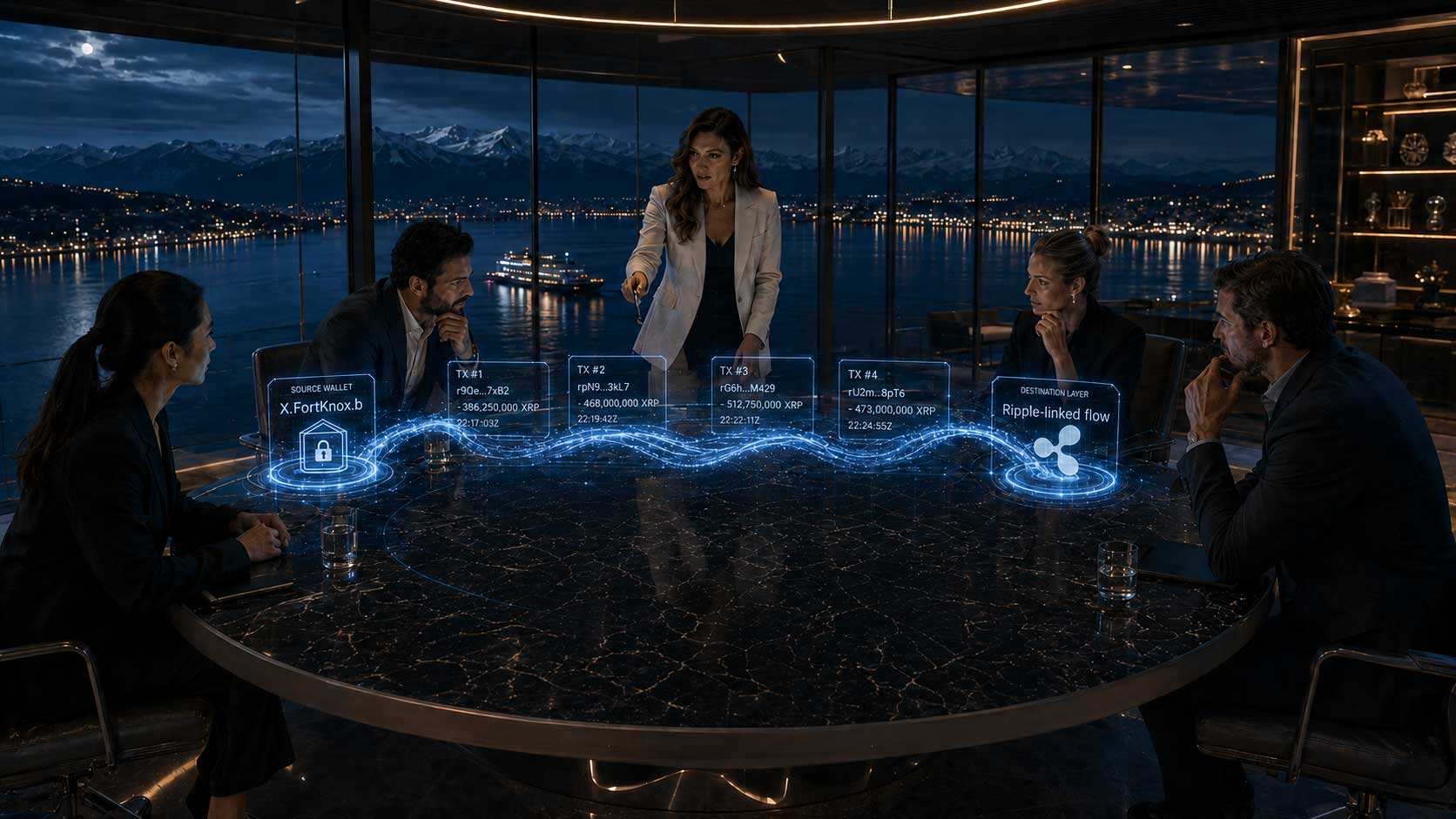
Inside, the team gathered around a circular black-marble table. Five transaction panels floated in a curved line above it, their blue-white light reflected against the polished surface.

For ten days, Noa had rebuilt Fior’s transfer sequence from the wallet names outward, checking timestamps, matching receiving addresses, and separating what was visible from what was inferred. By the time she stood at the table, she was no longer presenting a theory. She was presenting a sequence.

“January 26, 2013,” she said.

The first panel brightened.

8,000,000,000 XRP.

Then the second.

8,000,000,000 XRP.

Then the third.

8,000,000,000 XRP.

The fourth and fifth followed.

9,000,000,000 XRP.
9,000,000,000 XRP.

Outside, the Aegean moved slowly beneath the morning light. On the table, the ledger drew its own trails — arcs of luminous blue connecting one wallet to another, each movement clean, mathematical, and enormous.

Jalen leaned back. “That is forty-two billion XRP.”

Noa nodded. “Within minutes, according to the transaction sequence in Fior’s dossier.”

“Nearly half the total fixed supply,” Tariq said.

Rhea corrected him instantly. “Total supply, not circulating supply. We do not know how much was practically liquid at the time. And we still need independent verification of each wallet and transaction hash.”

Tariq accepted the correction. “Fair.”

Elena watched the five arcs form above the table. The pattern was elegant, and that made it intellectually dangerous. Clean sequences can tempt the mind into certainty before the evidence allows it. A number can become a theory. A name can become a doctrine. A coincidence can start to look like design unless someone forces it back into proportion.

But this was not nothing.

Fior’s investigation had identified five early XRP transfers on January 26, 2013, each allegedly moving between eight and nine billion XRP into wallets labeled by number: #10, #11, #12, #13, and #14. He framed them as among the earliest major XRP distribution events visible on-chain — not as proof of hidden intent, but as a scale event too large to ignore.

Noa expanded the first wallet panel. A long address appeared, then the amount, then the timestamp. Then the next. Then the next. Each transaction sat close to the others, like chambers opening in sequence.

Jalen rubbed his jaw. “There are normal explanations. Early supply allocations. Founder distributions. Internal treasury movements. Technical wallet organization. Exchange preparation. Escrow planning before escrow existed.”

Elena looked at him. “Good. Protect the investigation from becoming a belief system.”

Tariq walked toward the open terrace, where the first sun had touched the white buildings across the cliffside. “Still, the scale matters. Even if the movements were ordinary by internal standards, ordinary internal movements at this scale tell us something about architecture.”

Rhea crossed her arms. “They tell us XRP began as a highly concentrated asset.”

“Yes,” Tariq said. “And concentration is not merely ownership. In a settlement system, concentration can be preparation.”

“Or control,” Jalen said.

“Sometimes those are the same thing.”

Noa moved the transaction arcs into a timeline. The five panels arranged themselves by minute.

“Look at the timing,” she said. “The transfers are not scattered across weeks. They appear clustered. Whatever the purpose, this was coordinated.”

Rhea stepped closer. “Coordinated does not mean secret. It may only mean administrative.”

“Agreed,” Noa said. “But administrative structures are exactly what we are looking for.”

Not conspiracy.

Structure.

A settlement network did not become globally relevant because someone gave it a dramatic story. It became relevant because its structure could handle value at scale: speed, liquidity, finality, distribution, market access, custody, and regulatory adaptation.

The Fort Knox names had raised the question. The distribution event changed the size of it.

Noa opened a new overlay. The five transfers curved outward from a central origin point, then paused in the air as glowing blue bridges. Beneath them, she added a simple label:

Early Distribution Architecture

Rhea studied the map. “If we verify these transfers, we still have three questions. Did they happen as described? Were the receiving wallets part of the FortKnox-labeled structure? And does that structure have any meaningful relationship to later Ripple flows, institutional custody, or tokenized reserve theory?”

Tariq turned back from the terrace. “And the fourth question?”

Rhea looked at him.

“Why someone chose these labels in the first place,” he said.

The room went still again.

Outside, waves moved against the cliffs. The horizon shifted from violet to gold. The villa seemed to float between eras: ancient sea below, digital value above, and five people trying to read the architecture of a system whose earliest pages were missing.

Elena stopped beside the center point where the transaction arcs began.

“The mistake would be to claim this proves XRP was designed as a gold-backed asset,” she said. “The second mistake would be to pretend this scale, timing, and naming pattern mean nothing.”

That was the tension now. Not belief versus disbelief. Evidence versus probability.

Noa dimmed the room lights. The five transfers glowed brighter.

“Eight billion. Eight billion. Eight billion. Nine billion. Nine billion,” Tariq said.

“Forty-two billion total,” Rhea added.

Jalen leaned forward. “And all of it moving at the beginning of the visible story.”

“No,” Elena said. “Not the beginning.”

She tapped the table once, and the number from Singapore returned in the corner of the display.

32,570

“This is what happened after the beginning vanished from public view.”

No one spoke for several seconds.

The Fort Knox wallet had been a name. The distribution event was movement. And movement was harder to dismiss.

Because money always revealed itself in motion.

Motion alone was not enough. To understand whether the movement was accidental, administrative, or architectural, they needed to find the source that had sent so much value outward. The answer waited in Tokyo, inside the wallet Fior had named as the distributor.

In Tokyo, X.Distributor.1 appears at the center of the machine, linking allocation, structure, and the Fort Knox sequence.

The Distributor

Nearly two weeks passed before the team reconvened in Tokyo. The Santorini transfer map had raised the next question: if forty-two billion XRP had moved outward, what had stood at the center of that movement?

Tokyo received them in rain.

It fell in clean silver sheets against the windows of the private sky lounge, turning the city below into a living circuit. Shibuya pulsed beneath them, its crossings and towers blurred through the glass, every advertisement and traffic signal dissolving into color. Farther out, the skyline climbed into darkness, dense with money, code, and ambition.

The room itself was quiet. No music. No assistants. No servers visible. Only rain, glass, and the soft hum of the projection engine.

Elena and the team were in Tokyo for a private blockchain liquidity workshop, where engineers, exchange operators, and institutional market makers were discussing routing, settlement depth, and wallet architecture. It was the right city for that conversation. Tokyo understood structure beneath motion: trains arriving to the second, crowds flowing without chaos, old temples standing beside automated towers. If Santorini had revealed movement, Tokyo was where movement became system.

During the days between meetings, Rhea and Noa had worked backward from the transfer cluster, testing whether the visible flows pointed to a common source. The answer did not arrive as revelation. It arrived as a pattern repeating too cleanly to ignore.

At the center of the lounge, a single wallet hovered above the table.

X.Distributor.1

It was larger than the others — not visually, but conceptually. The system rendered it as a bright central node, surrounded by smaller vault-shaped markers. Blue-white streams extended outward from it, each connecting to a FortKnox-labeled receiving wallet.

Noa stood beside the projection, her face lit by the data. “Fior’s dossier identifies this as one of the largest early XRP distribution wallets in the visible record. Reported genesis balance: nearly eighty billion XRP.”

Jalen looked up sharply. “Nearly eighty billion?”

Rhea answered before Noa could. “Reportedly. Fior gives the figure as 79,997,608,219 XRP. We verify it before we treat it as fact.”

Tariq sat forward. “That number matters.”

“Of course it matters,” Jalen said. “It would represent almost the entire original allocation associated with the company-side distribution structure.”

Rhea brought up the next layer.

Around X.Distributor.1, the FortKnox sequence appeared again.

X.FortKnox.2
X.FortKnox.3
X.FortKnox.4
X.FortKnox.5
X.FortKnox.6
X.FortKnox.7
X.FortKnox.8
X.FortKnox.9

The projection drew lines from the distributor wallet into each of them.

A central source. A numbered vault series. Billions moving outward.

Fior’s investigation claimed that X.Distributor.1 originally held nearly eighty billion XRP and that, on January 26, 2013, massive distributions were sent into several FortKnox-labeled wallets. His dossier listed the receiving names as X.FortKnox.2 through X.FortKnox.9, with transfers allegedly ranging from eight billion to nine billion XRP per wallet. If verified, the structure was no longer just a strange naming pattern. It was a distribution map.

Rhea folded her arms. “This is where people get reckless.”

“Because the pattern is tempting,” Tariq said.

“Because the pattern is incomplete,” Rhea said. “We do not know who named the wallets, whether the labels were operational or symbolic, or whether ‘Fort Knox’ meant gold, security, reserves, internal vaulting, or nothing at all.”

Noa added, “But the labels appear in a sequence.”

“If verified,” Rhea said.

Elena walked closer to the projection. The central wallet glowed like a digital sun over the table, sending blue currents into the surrounding nodes.

Then she said the line that would later become the title of the team’s private file.

A name can be coincidence. A sequence becomes architecture.

The rain filled the silence.

Jalen looked at the glowing FortKnox nodes. “That quote is dangerous.”

“Only if we mistake architecture for proof,” Elena said.

Tariq smiled faintly. “But architecture is not nothing.”

“No,” Elena said. “It is not.”

She expanded the display into a three-dimensional model. The wallet structure rose from the table: missing ledgers at the base, early distribution wallets above them, FortKnox-labeled vault nodes above that, and later flows still waiting to be traced.

It looked less like a transaction map now.

It looked like a building.

Rhea studied the model. “This chapter should not claim discovery of a gold-backed system.”

“No,” Elena said. “It should claim discovery of a distribution structure worth investigating.”

“Stronger because it is defensible?” Tariq asked.

“Stronger because it is honest,” Elena said.

The lounge lights dimmed as the rain intensified. Tokyo shimmered around them, every tower catching fragments of reflected data. The city understood layers: ancient temples beside automated trains, paper contracts beside digital wallets, old family capital beside new machine intelligence.

XRP belonged to that same contradiction.

A new system with an old question hidden inside it.

Who controls the first movement of value?

Noa highlighted the reported distributor balance again.

79,997,608,219 XRP

Jalen stared at the number. “If accurate, this was not merely a large wallet. It was the distribution center of gravity.”

Rhea nodded. “Yes.”

“And if the FortKnox wallets received from it, they were not random isolated accounts.”

“No,” Rhea said. “They would be part of the allocation structure.”

Tariq leaned back. “A distributor and vaults.”

“Careful,” Jalen said.

“I am being careful. I did not say gold. I said vaults.”

Elena let the distinction hang in the room.

Not gold-backed. Not secret Treasury system. Not proof of hidden sovereign design. But a reserve-like vocabulary appeared to be embedded inside the earliest visible wallet structure: distributor, FortKnox, massive allocation, numbered receiving nodes.

The language mattered. The scale mattered. The timing mattered. Whether the meaning was operational or symbolic remained unknown.

Rhea moved to the window and looked down at Tokyo. “Suppose the naming was just internal shorthand. Fort Knox equals secure wallet. Distributor equals distribution wallet. That is entirely plausible.”

“Then we have learned something important,” Elena said. “Even the mundane explanation points to reserve-like thinking: custody, allocation, liquidity.”

Noa saved the model under a new label.

Early Allocation Architecture — FortKnox Series

The projection shifted again. The FortKnox nodes faded, and the central wallet remained. X.Distributor.1 hovered alone above the table.

For a moment, it looked less like a wallet and more like an unanswered question.

Tariq spoke softly. “If XRP were only a speculative token, this architecture would still be historically important. But if XRP was designed as settlement and liquidity infrastructure, then this is more than history. It is a blueprint.”

Rhea did not challenge him immediately.

That was new.

Outside, the rain broke against the glass, and the city below kept moving.

Elena closed the projection with a gesture, leaving only one line suspended in the air.

What was being distributed — tokens, liquidity, or future settlement power?

The line faded.

They had entered through a missing beginning, found a Fort Knox name, followed a massive distribution event, and reached the distributor itself.

For the first time, even Jalen looked less like a skeptic and more like a man beginning to understand the size of the machine.

Identifying the distributor was not the same as understanding the system. A center point explained where the movement gathered, not where it ultimately led. That question would require a different kind of room, a quieter map, and a city built for following value through silence.

Over Lake Geneva, the team follows the flow from symbol to transaction, tracing the path toward Ripple-linked movement.

Follow the Flow

Another week passed before Geneva. The Tokyo model had revealed a center point, but a center point was not a conclusion. It was a question with coordinates: where did the value go next?

Lake Geneva was still when they arrived.

The city lights rested on the surface like scattered coins, trembling only when a late ferry crossed the dark water. Beyond the glass walls of the conference suite, the Alps stood in moonlit silence. Geneva had always understood secrets better than most cities. Gold had passed through it. Treaties had passed through it. Private wealth had hidden behind its polished doors for generations.

The team was in Geneva for a private digital-assets custody summit, where the official agenda focused on institutional wallets, reserve transparency, settlement risk, and tokenized securities. The setting suited the next stage of the investigation. Geneva understood custody without spectacle. Value moved there through banks, trusts, vaults, treaties, and agreements that rarely announced themselves. If Tokyo had shown them the structure, Geneva was where they would test whether that structure had a path.

For days, Noa and Rhea had rebuilt the movement forward instead of backward, tracing addresses across years and separating three categories: visible transactions, explorer labels, and interpretation. One wrong assumption could turn a trail into fiction.

Inside a suspended glass room above the lake, the team followed a different kind of trail.

Not paper. Not bullion. Not signatures.

Movement.

A three-dimensional transaction path floated above the table: wallet to wallet, year to year, node to node. At the far left was the origin marker.

X.FortKnox.b

At the far right was the destination layer.

Ripple-linked flow

Between them, the path unfolded.

Rhea read from the verified working notes. “Fior’s dossier claims that XRP from X.FortKnox.b moved through multiple wallets before later entering Ripple-linked accounts. The described path begins with 1.840 billion XRP sent from X.FortKnox.b to rBtVhMKcyiJJqyLTKqJdZSZrLEA5JAXjB1 on December 19, 2013. Then the same amount allegedly moved to rnNqkPMMnrFdiq7uN1r4uAjq7Tvab4xgvL on March 3, 2016. Later, funds moved again to r9kkWNia8PmpR44L7mWZn33Hpff3CCzLjA on May 3, 2017. That wallet is then shown sending 4.668 billion XRP directly to Ripple, with the memo rt1.4.3-13-g582a3a5.”

Jalen stared at the path. “That is the most important trail so far.”

Noa nodded. “Because it moves from symbolic territory into operational territory. A wallet name is symbolic. A transfer path is operational. That does not prove intent, but it gives us something testable.”

Elena stood near the window, watching the data reflect across the lake. The Fort Knox labels had opened the door. The distribution event had widened it. This path invited them to walk through.

Tariq leaned closer to the memo.

rt1.4.3-13-g582a3a5

It hovered above the final transaction like a small technical scar.

“That does not look like a casual note,” he said.

“No,” Rhea answered. “But we should not overread it.”

She enlarged the memo and split it into possible components.

rt
1.4.3
13
g582a3a5

“Fior’s analysis suggests RT could refer to Ripple Trade, 1.4.3 could be a software version, 13 could be a build number, and g582a3a5 could resemble a Git commit hash or internal developer reference.”

Jalen crossed his arms. “Could. Could. Could.”

“Yes,” Rhea said. “That is the correct word.”

Tariq did not look away from the memo. “But it has structure.”

“So does a receipt number,” Jalen said.

Elena turned from the window. “And a receipt number proves a transaction belonged to a process.”

The room went quiet.

Noa let the memo rotate slowly in the air.

The name raised the question. The movement gave it weight. The memo made it look internal.

Jalen exhaled. “That quote is dangerous.”

“Only if we remove the word ‘look,’” Elena said.

That was the discipline: preserve uncertainty without draining force. The ledger did not care about belief. It recorded movement.

Noa expanded the full flow again. The first node pulsed: X.FortKnox.b. A blue arc moved forward through time to the next address. Then another. Then another. Finally, the line merged into a Ripple-labeled endpoint.

Rhea walked around the table. “The phrase ‘Ripple-linked’ needs careful handling. Direct Ripple accounts, explorer labels, accounts that transacted with Ripple, and accounts controlled by Ripple are not always the same thing.”

“Agreed,” Elena said.

Tariq nodded. “But if the final transaction was directly to Ripple, as Fior’s dossier claims, then the trail matters.”

“It matters,” Rhea said. “It just does not automatically mean what people will want it to mean.”

Jalen looked toward Elena. “Then what does it mean?”

“It means early XRP from a FortKnox-labeled source appears, according to Fior’s dossier, to travel through a sequence of wallets and eventually intersect with Ripple’s operational sphere. Enough to investigate. Not enough to declare.”

The phrase appeared in the corner of the display.

Enough to investigate. Not enough to declare.

Outside, a soft wind moved across the lake. The reflection of the city broke apart, then reassembled itself. The movement reminded Elena of the ledger path: value leaving one address, appearing in another, carrying history but not always explanation.

Rhea isolated the final transaction.

The memo remained.

rt1.4.3-13-g582a3a5

“What bothers me,” she said, “is not that it looks technical. Technical memos are normal. What bothers me is that it appears on a transaction this large, attached to a path this interesting, after a sequence this symbolically loaded.”

Jalen sat back slowly. “Now you are starting to sound like Tariq.”

“I am saying it may mean process,” Rhea said. “Internal process. Software process. Migration process. Accounting process. Treasury process. We do not know.”
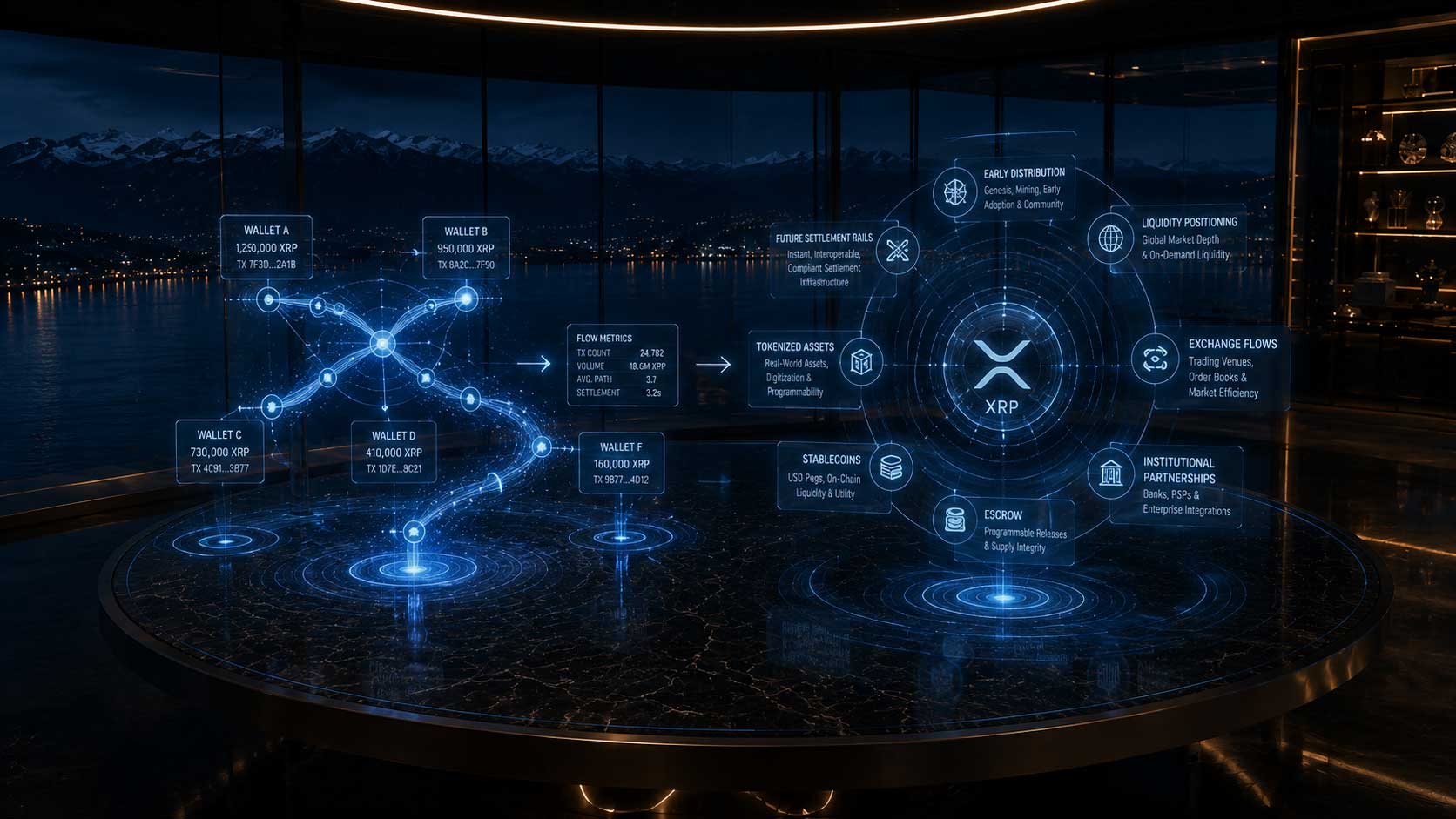
Tariq opened a secondary model beside the transaction path. It showed XRP’s broader evolution: early distribution, liquidity positioning, exchange flows, institutional partnerships, escrow, stablecoins, tokenized assets, and future settlement rails.

“This is why the path matters,” he said. “Not because it proves a Fort Knox theory. Because it suggests that from the beginning, XRP existed at institutional scale. Whatever the public later called it — coin, token, bridge asset, liquidity tool — the early movements were not small. They were architectural.”

Jalen looked at the model, then at the lake. “Architectural.”

He was still skeptical. Good. They needed him skeptical. But he was no longer dismissive.

Noa dimmed all nodes except the final memo.

A technical trace. A possible internal marker. A fragment of process. A clue with no confession attached.

Elena walked closer. “People want hidden systems to announce themselves with symbols. They rarely do. More often, they leave behind boring things: version numbers, wallet labels, distribution records, memos no one thought would matter ten years later.”

Jalen moved toward the glass. “So where are we?”

Elena looked at the full path one more time. “Past the point where this can be dismissed as a single strange wallet name. Not yet at proof.”

Tariq looked from the FortKnox origin to the Ripple endpoint. “Then what is this chapter really about?”

“Flow,” Elena said.

Noa smiled. “Follow the flow.”

The words appeared at the bottom of the projection.

FOLLOW THE FLOW.

Below it, the system added a second line.

The ledger does not lie. It only reveals what time confirms.

No one removed it.

The lake remained dark. Geneva remained quiet. The Alps watched from the edge of the world.

The Fort Knox mystery was no longer about a name. It was about whether the earliest visible movements of XRP pointed toward ordinary allocation, internal treasury management, or the first outlines of a liquidity system built long before the world knew how badly it would need one.

Flow had given them movement, not motive. The next question was who had touched the path, who had tested it, and whether the human layer changed the probability map. The signal waiting ahead was almost absurdly small after billions: one hundred XRP.
In Monaco, the smallest signal becomes the hardest to ignore: one hundred XRP before a much larger movement.

The Hundred XRP Test

Nine days passed before Monaco. The team spent them arguing over attribution: what could be proven, what could only be inferred, and where a wallet label ended and a human decision began.

Monaco appeared at twilight like a jewel set into the edge of the sea.

The coastal estate sat high above the harbor, wrapped in glass, limestone, and silence. Below, yachts rested in dark blue water, their lights trembling against the surface. Farther out, the Mediterranean stretched into the last gold of the day, calm enough to look permanent.

Nothing about the view suggested danger. That made it the perfect place to study founders.

Elena and the team were in Monaco for a tokenized wealth summit, where private banks, family offices, custody firms, and legal architects were debating how ownership would survive the move from paper claims to programmable assets. Monaco gave the question its proper setting. Wealth there rarely looked hurried. It sat behind glass, under flags, inside registries, trusts, family offices, private banks, and names that meant more than they revealed. If Geneva was where value moved quietly, Monaco was where ownership learned to disappear into elegance.

For the first time, the investigation was not only about wallets. It was about attribution. Rhea had warned them twice: a transaction could be visible, an address could be labeled, and the interpretation could still be wrong. That warning followed them into the room like a sixth presence.

Inside the estate’s open-air observatory, the team gathered around a low circular projection well built into the floor. Unlike the previous transaction maps, this one did not show a clean sequence. It showed overlap, intersections, possible attribution — wallet histories layered like transparent sheets.

At the center floated the wallet they had followed in Geneva:

r9kkWNia8PmpR44L7mWZn33Hpff3CCzLjA

Noa stood barefoot on the edge of the glass floor, tablet in hand, her face lit by the blue glow rising from below.

“This is the wallet Fior’s dossier connects to the FortKnox.b trail,” she said. “It allegedly received funds that originated from the Fort Knox-labeled path before later sending billions of XRP to Ripple.”

Rhea watched from a chair near the terrace. “And now we are looking at the founder connection.”

Jalen shifted in his seat. “This is the most dangerous chapter. People mistake proximity for conspiracy.”

Elena nodded once. “Then we will not make that mistake.”

Noa expanded the next data layer.

100 XRP

The number looked almost absurd after everything they had studied: eight billion, nine billion, forty-two billion, nearly eighty billion in distributor claims. Against that scale, one hundred XRP seemed like dust.

The room did not relax.

Small transactions often carried information that large ones concealed.

Fior’s dossier claims that on January 3, 2016, this wallet received a small 100 XRP test transaction from an address attributed to Jed McCaleb, and that the same founder-linked source may have activated the wallet. Minutes later, the same wallet allegedly received 19 million XRP from an address identified in the dossier as McCaleb’s “Tacostand” wallet.

The name hovered in the air.

Jed McCaleb

Founder. Architect. Departure point. Permanent figure in XRP’s origin story.

Jalen leaned forward. “Early Ripple founder wallets interacting with early Ripple-era wallets is not shocking. It may be normal: administrative, settlement-related, or part of known founder allocations.”

Tariq studied the projection. “Normal does not mean irrelevant.”

“No,” Jalen said. “But relevant does not mean suspicious.”

That was the line they had been walking since Singapore.

Elena stepped down into the projection well. Above her, the 100 XRP test transaction and the 19 million XRP transfer floated side by side.

One small. One large. Both potentially meaningful.

A test transaction is rarely about value alone. It is about access, control, and confirmation.

Noa opened a second timeline: early XRP creation, founder allocations, Ripple formation, internal distributions, later disputes, public sales, escrow decisions, institutional partnerships. The founder signal did not sit outside the XRP story. It sat inside the messy reality of how new financial technologies are born.

Not cleanly. Not mythically. Through people, companies, wallets, agreements, exits, and records later generations try to interpret.

Tariq walked toward the terrace, where harbor lights sharpened against the darkening water. “Fior’s framing suggests that the founder connection does not prove the Fort Knox trail — but it makes the trail harder to dismiss outright.”

“That is emotionally effective,” Rhea said. “But analytically incomplete.”

Jalen pointed at the display. “Founder-linked activity can confirm proximity to early Ripple operations. It does not confirm gold, Treasury involvement, or a hidden reserve system.”

Noa nodded. “But it could help establish that the wallet path touched people close to the original architecture.”

The wallet address rotated slowly. Around it, the system displayed relationship categories in separate rings.

Confirmed transaction
Claimed attribution
Known founder context
Speculative implication

Rhea had insisted on that structure. Every fact had to be separated from every interpretation. No blending. No dramatic fog. No pretending a question was an answer.

Noa highlighted the alleged 100 XRP test transaction again. “If the activation and test transaction link is accurate, then this wallet was not random. It was touched by someone with direct founder-level relevance.”

Jalen said nothing.

“I agree that it would matter,” he said finally. “I do not agree that it proves what Fior’s dossier may imply.”

Elena nodded. “Good. Then that becomes the chapter’s purpose.”

Noa saved a new heading into the story file.

Proximity Is Not Proof

The projection shifted again. A small pulse of light left one founder-linked node, entered the central wallet, then a larger pulse arrived minutes later. The animation did not dramatize more than Fior’s dossier claimed. It showed sequence. Touch. Transfer. Connection.

“What bothers me,” Jalen said, “is that the 100 XRP transaction came first.”

Rhea looked at him. “Why?”

“Because that is how you test a path before moving value. You send a small amount, confirm the destination, then move more.”

Noa’s eyes sharpened. “That is the implication Fior wants investigated.”

“I know,” Jalen said. “And I hate that it is reasonable.”

No one was claiming proof. No one had crossed the line. Still, the founder signal had done what signals do. It changed the map.

Elena walked slowly around the edge of the projection well. “The founder-linked transactions, if verified, suggest that the wallet connected to later Ripple flows may also have interacted with addresses associated with one of XRP’s original founders. That places the wallet closer to the early human architecture of XRP. It does not tell us why. It does not tell us intent. It does not tell us whether the Fort Knox labels were symbolic, operational, or accidental.”

Rhea added, “And it absolutely does not prove gold backing.”

“No,” Elena said. “It does not.”

The Mediterranean darkened beyond the glass. Monaco glittered below like a marketplace for the old world’s confidence: sovereign wealth, private banks, family offices, luxury assets, silent deals.

A fitting place, Elena thought, to ask what a founder leaves behind.

Not legacy.

Evidence.

Jalen approached the projection and looked at the small 100 XRP marker.

“People will focus on the nineteen million,” he said.

“They will,” Elena replied.

“But the one hundred is more interesting.”

Tariq nodded. “Because it suggests possible intention before scale.”

Elena looked at the team, then at the floating wallet address.

They had begun with a missing beginning. They had found Fort Knox names. They had mapped distribution. They had reached the distributor. They had followed the flow toward Ripple. Now, they had touched the founder layer.

Still no verdict.

But the probability map was no longer empty.

Elena closed the projection until only three elements remained suspended above the floor:

100 XRP
19,000,000 XRP
Founder proximity

Then she added the final line of the chapter.

Not proof of the theory. Proof that the origin story still had rooms left to search.

The next room was not inside the ledger. It stood in Washington, built from signatures, institutions, public trust, and the long memory of gold.

In Washington, the ledger trail enters the language of institutions: Treasury, Fort Knox, public trust, and Ripple governance.

The Treasury Layer

Two weeks passed before the team gathered in Washington. The pause was deliberate. After Monaco, Elena refused to let the investigation drift from evidence into biography. Every human connection had to be placed carefully, weighed against the ledger, and separated from the conclusion people would want to draw too quickly.

Washington, D.C. looked different from above.

Not taller than Dubai. Not brighter than Tokyo. Not more elegant than Geneva or Monaco. But heavier.

The city carried weight in its geometry. Avenues cut through the capital with ceremonial precision. Monuments stood like fixed points in a national equation. The Treasury building, lit in warm stone and shadow, held its place near the heart of the old financial order.

Elena had chosen Washington because the next layer was institutional, not technical. No transaction hash could explain why signatures mattered, why reserves inspired confidence, or why a person who had once stood inside the machinery of public money might later matter to a company building private settlement rails. Washington was where symbols became policy, and policy became power.

From the rooftop garden of a private residence, Elena watched the last light fade behind the capital dome. Below them, power did not announce itself with towers. It endured through institutions.

For days, Rhea had rebuilt the evidence grid around Rosie Rios with the same caution she had applied to wallet addresses: confirmed facts in one column, contextual claims in another, symbolic implications held apart from conclusions. If they brought a Treasury figure into the story, they would do it without turning biography into proof.

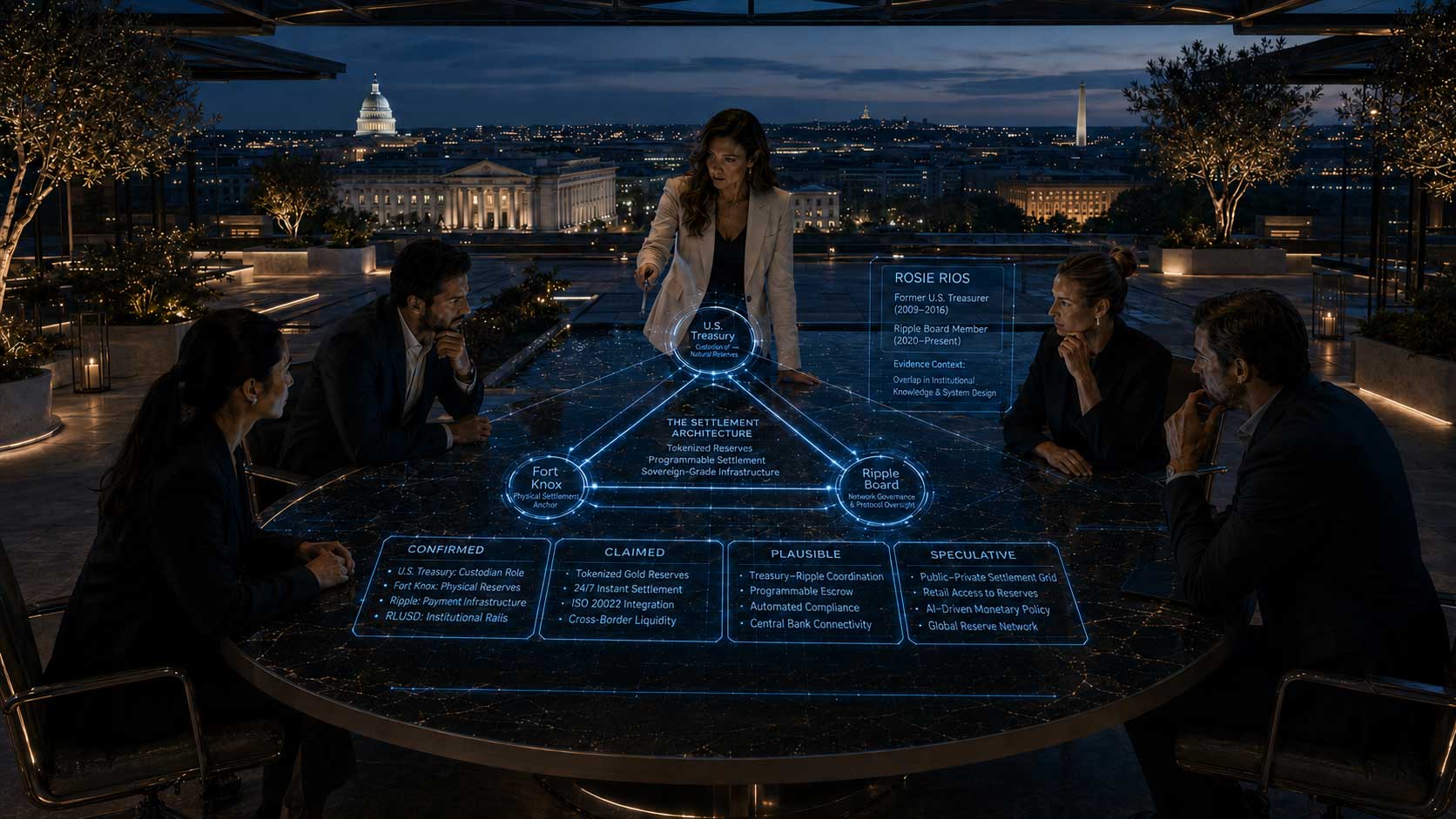
The team gathered under a glass canopy surrounded by olive trees, white stone planters, and a shallow reflecting pool that caught the gold of the evening sky. At the center of the garden, a triangular holographic display hovered above a black granite table.

Three points formed the triangle.

U.S. Treasury
Fort Knox
Ripple Board

Rhea stared at it with visible discomfort. “This is where the story gets most vulnerable.”

Jalen nodded. “People love human connections. They are easier to understand than ledger flows.”

Noa adjusted the projection. A portrait appeared on one side of the triangle.

Rosie Rios

Former Treasurer of the United States.

The signature layer appeared next: U.S. currency, official Treasury role, Bureau of Engraving and Printing, U.S. Mint, gold reserves, Fort Knox.

Then another layer appeared.

Ripple Board of Directors

Fior’s dossier placed Rosie Rios into the probability map carefully: former U.S. Treasurer, signature on U.S. currency, later Ripple board member, and historically connected to Treasury-era oversight involving U.S. gold reserves at Fort Knox. The implication was not subtle: a person connected to national monetary symbolism and gold-reserve oversight later entered the governance orbit of a company deeply tied to XRP.

Jalen stepped closer. “Important people join important companies. Former public officials join boards, advisory groups, banks, foundations, defense firms, energy companies. That is normal institutional migration. We cannot treat this as proof.”

“We will not,” Elena said.

Tariq studied the triangle. “Still, it adds context.”

“Context is not causation,” Jalen said.

“No,” Tariq replied. “But context changes probability.”

The garden fell quiet. Somewhere over the Potomac, a helicopter moved through the dark. Washington glowed with the controlled dignity of marble and surveillance, a city built less to reveal decisions than to preserve the appearance that decisions had always been inevitable.

Elena touched the projection. The triangle rotated.

At one corner, Fort Knox appeared not as a bunker, but as an icon: a protected reserve. At another, XRP appeared not as a coin, but as a network asset moving through global rails. At the third, Rosie Rios stood as a human bridge between monetary history and fintech governance.

Rhea crossed her arms. “This is symbolic.”

“Mostly,” Elena said.

“Symbolism is weak evidence.”

“Alone, yes.”

Jalen looked at her. “And with the wallet names?”

Elena did not answer immediately. That was the honest difficulty. One symbol was weak. A cluster of symbols, large flows, early distribution architecture, technical memos, founder proximity, and institutional figures did not automatically become proof. But they did become a pattern worth examining.

Noa opened the evidence framework they had built in Monaco.

Confirmed
Claimed
Plausible
Speculative

She placed Rosie Rios carefully.

Under Confirmed: former U.S. Treasurer.
Under Confirmed: later Ripple board member.
Under Claimed / Contextual: Treasury-era Fort Knox gold-reserve oversight reference cited in Fior’s dossier.
Under Speculative: evidence of hidden XRP gold-backing.

Rhea nodded. “That is how we do it.”

Elena looked at the Treasury building in the distance.

One connection is coincidence. Two connections are curiosity. A pattern demands discipline.

The quote enlarged briefly above the table, then faded into the evidence grid.

Tariq walked to the reflecting pool. Its surface mirrored the Treasury building in miniature. “The public thinks money is backed by things: gold, government, military power, tax authority, trust. But underneath all of it, money is backed by settlement. If a claim cannot settle, it eventually fails.”

Jalen looked at him. “That is the first thing you have said tonight I fully agree with.”

Tariq gestured toward the projection. “Then follow that. What was XRP designed to solve? Settlement. Liquidity. Bridging between systems. Moving value across ledgers and borders. If the world tokenizes gold, debt, commodities, currencies, and securities, the question is not whether those assets exist. The question is how they settle against one another.”

Noa added a new layer to the display.

Tokenized Reserves

Gold bars transformed into digital claims. Treasury assets became ledger entries. Stablecoins moved beside CBDC corridors. Commodity tokens flowed across institutional networks. XRP appeared as a neutral bridge line between asset pools.

Rhea watched carefully. “That is the strongest version.”

Elena glanced at her. “Say it.”

Rhea exhaled. “The strongest version is not that XRP is secretly backed by Fort Knox gold. The stronger argument is that XRP may be positioned for a tokenized reserve world where gold, fiat, debt, and commodities all require settlement infrastructure.”

Jalen pointed at her. “That is defensible.”

“And less sensational,” Tariq said.

“Good,” Elena replied. “Less sensational usually means closer to useful.”

The display shifted again. The Fort Knox wallet names appeared on one side, the Treasury connection on another, and the tokenized reserve model above both.

The system generated a probability map.

Not a conclusion.

A map.

Historical symbolism
Early wallet naming
Large-scale distribution
Ripple-linked flows
Founder proximity
Treasury-era human bridge
Future tokenized settlement demand

The lines between them glowed faintly, not solid enough to claim certainty, but bright enough to refuse dismissal.

Rhea stepped closer. “The danger is that readers will want us to say the hidden thing out loud.”

“The hidden thing sells,” Jalen said.

Elena watched the map. “We do not write to satisfy the reader’s hunger for certainty. We write to sharpen the reader’s ability to see structure.”

Below them, cars moved through Washington’s avenues. Somewhere inside the government district, policy memos, budget models, defense briefings, bank regulations, and monetary strategy papers moved through secure systems. The old financial world was not dead. It was adapting.

The future did not replace the old order all at once.

It absorbed it.

It tokenized it.

It gave it faster rails.

Tariq returned to the table. “So Rosie Rios is not proof.”

“No,” Elena said.

“But she is a signal.”

“A contextual signal,” Rhea corrected.

Noa opened a final visual: a U.S. dollar bill signature dissolving into a ledger signature, then into a validator confirmation. Old trust becoming digital trust. Institutional trust becoming programmable settlement.

It was beautiful.

It was also only metaphor.

Metaphor had a place, as long as it did not pretend to be evidence.

Rhea looked at the Treasury building one more time. “What should the reader understand at the end of this chapter?”

Elena answered slowly. “That the Treasury layer does not prove the theory. It widens the frame. XRP’s story does not live only inside crypto culture. It touches banking, settlement, reserve assets, public trust, regulatory systems, and the people who have spent their lives inside those institutions.”

Jalen added, “And board membership is not a confession.”

The rooftop lights warmed as the last blue of evening disappeared. The holographic triangle dissolved into a circle, and the circle became a settlement map.

Gold.
Dollars.
Stablecoins.
Treasuries.
Tokenized assets.
XRP.

Not backing.

Bridging.

Elena looked at the team. “We are almost ready for the final map.”

Tariq’s eyes stayed on the projection. “And the question?”

Rhea answered before Elena could. “Was XRP created only for payments, or for the tokenized architecture of global value?”

Jalen shook his head, but this time he was smiling. “That question is going to cause trouble.”

Elena turned toward the Treasury building, now glowing in the night.

“Good questions usually do.”

The question followed them beyond Washington. It moved through the evidence grid, through Fior’s unresolved claims, through every wallet name and transfer path they had tested. The final meeting would not be about proving the hidden thing. It would be about deciding which possibilities had survived discipline.

Not Backed - Bridged

At sunrise over open water, the team separates mystery from evidence and arrives at the stronger thesis: not backed, bridged.

Three weeks passed before the final meeting. Each of them used the time differently. Noa rebuilt the transaction maps. Rhea challenged every attribution. Tariq expanded the macro model. Jalen attacked every conclusion before anyone else could believe it too easily. Elena waited for the pattern to become either stronger or smaller.

The final meeting took place where land surrendered to water.

The observatory stood on a private island in the Indian Ocean, a circular glass structure built above a shallow reef. By day, the water around it revealed coral gardens below. By night, it became a mirror for the stars.

Just before sunrise, the horizon glowed with a thin line of gold.

They chose the island because it offered no institutional shadow. No Treasury stone. No banking history. No skyline performing power. Only water, light, and a room transparent enough to make concealment feel almost impossible. If Washington represented the old architecture of trust, this place belonged to the question of what trust might become.

Elena stood alone at the center of the room before the others arrived. The glass beneath her feet revealed slow waves moving under the structure. The sound of the ocean was quiet but constant, like breath.

A fitting place, she thought, to end an investigation about liquidity.

Not in a vault. Not in a bunker. Not in a sealed archive.

Above open water.

For once, no one arrived with a new revelation. That was the point. The investigation had gathered enough signals. Now it had to withstand reduction. What remained after the drama was removed? What survived when every claim was forced into its proper column?

The room brightened as the team entered one by one. Noa came first, carrying the verified notes. Rhea followed with the evidence framework. Tariq brought the macro model: tokenized gold, stablecoins, treasuries, CBDCs, commodities, sovereign reserves, and settlement corridors. Jalen arrived last, holding nothing.

That was deliberate.

His job was not to add evidence.

His job was to resist conclusion.

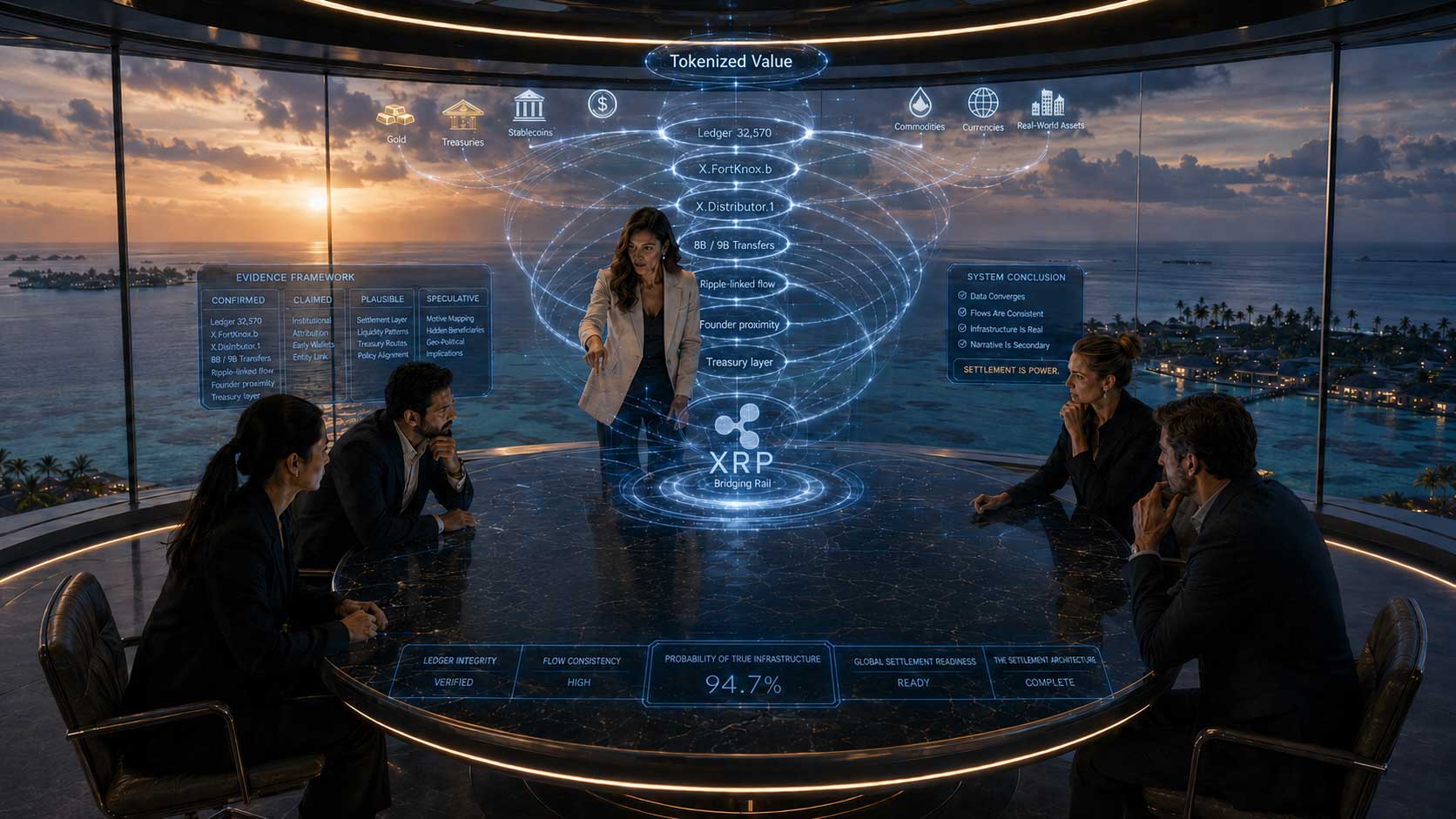
At the center of the observatory, a circular table rose from the floor. When Noa activated it, the entire investigation appeared above them as a single layered map.

At the bottom was the first marker.

Ledger 32,570

The missing beginning.

Above it appeared the early wallet layer.

X.FortKnox.b

Then the sequence.

X.FortKnox.2 through X.FortKnox.9

Then the distributor.

X.Distributor.1

Then the transfer cluster.

8B. 8B. 8B. 9B. 9B.

Then the trail.

FortKnox.b → intermediary wallets → Ripple-linked flow

Then the memo.

rt1.4.3-13-g582a3a5

Then the founder layer.

100 XRP test transaction
19 million XRP transfer
Founder proximity

Then Washington.

Treasury
Fort Knox
Ripple Board

Finally, above all of it, the future-state model appeared.

Tokenized Value

Gold. Treasuries. Stablecoins. Commodities. Debt. Currencies. Real-world assets. Central-bank settlement corridors. Bridge liquidity.

Between them, a blue line moved like current through water.

XRP

No one spoke for a while.

The map was beautiful.

That made Elena cautious.

Beautiful theories were the easiest to believe and the hardest to discipline.

Rhea opened the four-column evidence grid.

Confirmed

XRPL launched in 2012.
The first available public ledger history begins at ledger 32,570.
The original XRP supply was fixed at 100 billion.
Ripple became central to XRP’s early ecosystem and institutional development.

Claimed

The FortKnox wallet names.
The specific balances attached to those wallets.
The X.Distributor.1 balance.
The January 26, 2013 transfer cluster.
The wallet path from X.FortKnox.b into later Ripple-linked flows.
The founder-attributed test transaction and Tacostand connection.

Plausible

Early XRP architecture was designed around large-scale liquidity.
The wallet labels may reflect internal custody or allocation concepts.
The memo may represent a technical or operational process.
XRP may be well-suited for future tokenized settlement between asset classes.

Speculative

XRP was secretly designed as a Fort Knox gold-backed system.
The FortKnox wallet names prove Treasury involvement.
Rosie Rios’ Ripple board role proves a hidden monetary plan.
Early XRP distribution proves future gold-reserve backing.

Jalen looked at the grid and gave a slow nod.

“That is the cleanest version.”

“Because it does not pretend,” Rhea said.

Tariq stood near the glass wall, watching sunlight touch the ocean. “It still leaves the door open.”

“It should,” Elena said. “The evidence leaves the door open. It does not let us walk through and declare we found the room.”

Noa highlighted Fior’s final implication: if the Fort Knox connections, Treasury ties, and early wallet movements were meaningfully connected, XRP may have been designed as more than a digital asset — perhaps as infrastructure linking tokenized reserves, central banks, and global liquidity in a future settlement system.

Then she placed a warning beneath it.

Hypothesis, not conclusion.

The map shifted again. This time it showed a future simulation.

A tokenized gold claim moved from a sovereign reserve account into a liquidity pool. A tokenized Treasury note settled against a dollar stablecoin. A commodity shipment triggered an automated payment. A central bank corridor opened. An institutional wallet requested bridge liquidity. XRP moved between systems, not as the asset being bought, but as the rail that allowed value to cross from one form to another.

Gold did not move.

Claims moved.

Trust did not disappear.

It changed format.

Tariq watched the simulation with visible intensity. “This is the real thesis.”

Elena turned to him. “Say it carefully.”

He did.

“The strongest argument is not that XRP is backed by gold. The strongest argument is that XRP may be suited for a world where gold, fiat, debt, commodities, and securities are tokenized — and where those tokenized systems need fast, neutral settlement between them.”

Rhea nodded. “That is responsible.”

“And harder to dismiss,” Jalen said.

Outside, the sun broke the horizon. The observatory filled with gold light. For a moment, every surface reflected it: glass floor, table, water, faces, and the blue ledger map above them.

Gold and code.

Ancient trust and digital settlement.

The old symbol and the new rail.

Elena let the image hold.

Then she spoke.

The future may not be backed by gold. It may be settled through the systems that can move gold’s value.

No one objected.

Elena walked around the circular map. Each layer brightened as she passed.

“Here is what we know,” she said. “The public beginning of the XRP Ledger is incomplete. The earliest visible period contains large-scale allocation patterns. Fior’s dossier identifies Fort Knox-themed wallet names and a distributor structure. Some claimed flows appear to move toward Ripple-linked destinations. The founder layer, if verified, may show proximity to early human architecture. The Treasury layer widens the institutional frame.”

She paused.

“Here is what we do not know: whether the Fort Knox names were symbolic, operational, arbitrary, or intentionally monetary; whether the distribution structure was designed with future tokenized reserves in mind; whether any connection to gold was literal, metaphorical, or nonexistent.”

The group remained still.

Elena continued.

“And here is what matters most: XRP does not need to be secretly backed by gold to become important in a gold-tokenized world.”

Tariq’s eyes stayed on the simulation. “That sentence may be the bridge.”

“It is,” Rhea said.

Jalen leaned forward. “Because it separates the sensational claim from the durable thesis.”

Noa typed it into the final file.

XRP does not need to be backed by gold to become infrastructure for tokenized gold.

The sentence appeared in the air.

Clean. Defensible. Powerful.

For the first time, Elena felt the investigation settle into its proper shape.

Not a conspiracy. Not a dismissal.

A disciplined possibility.

Fior’s dossier had given them a trail: missing ledgers, FortKnox wallets, massive early transfers, distributor structures, Ripple-linked flows, founder signals, and Treasury symbolism. The team had not accepted the trail blindly. They had tested its weight, separated evidence from implication, and allowed the strongest version to survive.

That was how serious inquiry worked.

Not by killing mystery.

By refining it.

The simulation expanded into a global map. Lines of liquidity crossed oceans. Singapore, Dubai, Santorini, Tokyo, Geneva, Monaco, Washington, and the Indian Ocean observatory appeared as luminous points. Each location represented a layer of the investigation.

Missing beginning.
Wallet names.
Distribution.
Distributor.
Flow.
Founder.
Treasury.
Probability.

The locations connected into a single ring.

A consensus circle.

Noa smiled. “It looks like a validator network.”

Tariq laughed softly. “Of course it does.”

Rhea allowed herself the smallest smile. “Maybe that is too poetic.”

Elena looked at the circle. “Poetry is acceptable at the end, as long as the evidence came first.”

Jalen stood near the glass. Below him, the reef glowed beneath clear water. Fish moved through coral channels like tiny signals in a living network.

Finally, he turned back to them.

“I still do not believe the gold-backed claim.”

“No one is asking you to,” Elena said.

“But I no longer think the pattern should be dismissed.”

That was the final confirmation she needed.

The skeptic had not converted.

He had refined.

That was better.

The gold light softened into morning. The holographic map began to fade, but Elena stopped it before it disappeared entirely.

One final question remained suspended above the table.

Was XRP created only for payments, or for the tokenized architecture of global value?

No answer appeared beneath it.

That was intentional.

Some questions were too large for a single chapter.

Some were designed to open the next book.

Elena looked at her team.

“We do not end by telling them what to believe,” she said. “We end by showing them what must be investigated next.”

Tariq nodded. “Tokenized reserves.”

Noa added, “RLUSD.”

Rhea added, “Custody and regulation.”

Jalen added, “Proof.”

Elena smiled.

“Yes. Always proof.”

The ocean moved beneath them.

The ledger map pulsed once, then dissolved into the morning air.

For a moment, only the horizon remained.

Gold above water.

Light across glass.

Value waiting for rails.

And somewhere inside the invisible architecture of the future, a question continued to move.

Across cities, wallets, symbols, and flows, the question remains: was XRP built only for payments, or for the tokenized architecture of global value?

Author’s note: This fictionalized investigation was inspired in part by research and source material published by Edo Farina, whose work brought attention to early XRP Ledger wallet structures, Fort Knox-themed account names, and related on-chain questions. This story expands those ideas into a narrative framework for educational and creative purposes. Any interpretations, fictional characters, settings, and probability-based conclusions are the author’s own.

Scroll to Top