
After Friday’s Close
Table of Contents
ACT I — THE YEN
Tokyo Friday, September 4, 2026 7:42 A.M.
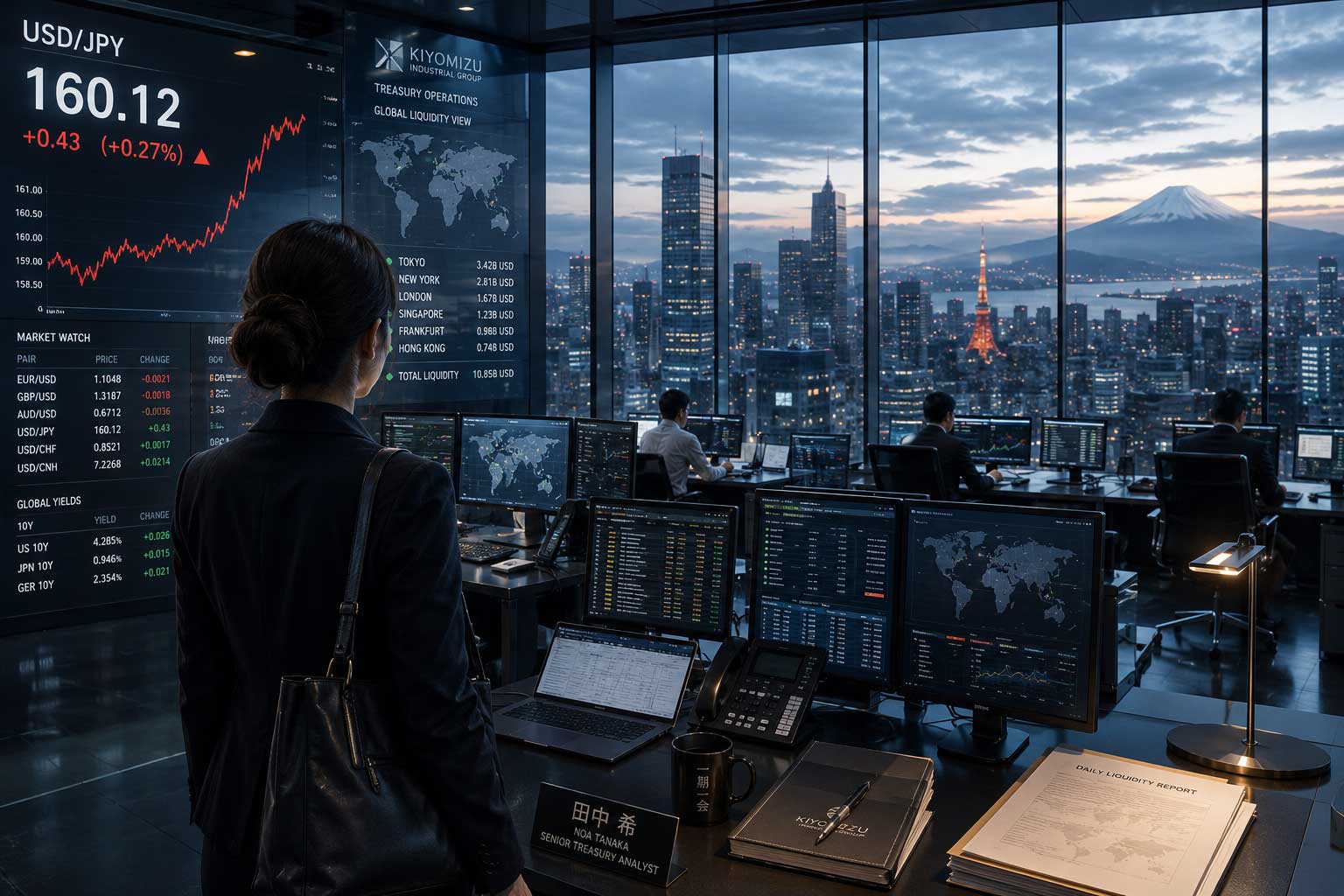
By the time Noa Tanaka reached the thirty-eighth floor, the yen had already moved forty-three basis points.
She noticed it before she reached her desk.
The treasury floor occupied the eastern side of the building, with an uninterrupted wall of glass overlooking Tokyo from Marunouchi to the pale morning haze above Tokyo Bay. At that hour the office was usually quiet. Analysts arrived with coffee, overnight reports were opened, and the first conversations of the morning took place in voices deliberately low enough not to disturb anyone.
Today, nearly everyone was standing.
Noa placed her bag beneath her desk and looked at the central display.
USD/JPY 160.12
She watched it change.
160.19
Nobody on the floor needed an explanation. For most of the summer, 160 had existed less as an exchange rate than as a political boundary. Japan and the United States had already demonstrated their willingness to defend the yen, including an extraordinary coordinated intervention several weeks earlier. For a time, it had worked.
Now the market was back.
Her terminal contained the overnight reports from New York and London. She ignored most of them and opened the company’s consolidated liquidity position.
Noa was thirty-three years old and had spent eleven of those years learning that large corporations rarely had a shortage of money in the conventional sense. They had money everywhere: operating accounts in Singapore, receivables in Germany, dollar deposits in New York, credit facilities in London, short-term securities held with custodians, subsidiaries generating cash in currencies that another subsidiary desperately needed.
The problem was getting the right money into the right place at the right time.
Her employer, Kiyomizu Industrial Group, manufactured everything from precision robotics to grid-scale power systems. It operated in forty-one countries and generated the equivalent of nearly $70 billion in annual revenue. On paper, the company possessed extraordinary liquidity.
Noa’s job was to determine how much of it could actually be used.
Her phone rang at 7:51.
“Hiroshi Sato.”
She smiled despite herself. “You call earlier every year.”
“I’m getting older.”
“That’s normally associated with sleeping later.”
“Not in markets.”
She heard voices behind him. Sato was already somewhere busy.
Noa leaned back and looked again at the yen.
160.31.
“I assume you’re watching it.”
“I’m watching.”
“Did you rerun your collateral model?”
She frowned.
“FX exposure, yes.”
“I didn’t ask about FX.”
Noa stopped.
Sato had spent three decades around Japanese rates and currency markets. Years earlier, when she was still a junior analyst, he had taught her a rule she initially considered ridiculous: when an experienced trader asks the wrong question, assume you have misunderstood the question.
“What collateral model?”
“The consolidated one. Dollar liabilities, derivatives, repo, everything.”
“We ran it yesterday.”
“Run it again at one-sixty-two.”
Noa turned toward her terminal.
“You think we’re going to 162?”
“I didn’t say that.”
“Then why—”
“Because I want to know what happens if the people who borrowed yen decide they don’t want to borrow yen anymore.”
The line remained quiet for a moment.
Noa understood what he meant.
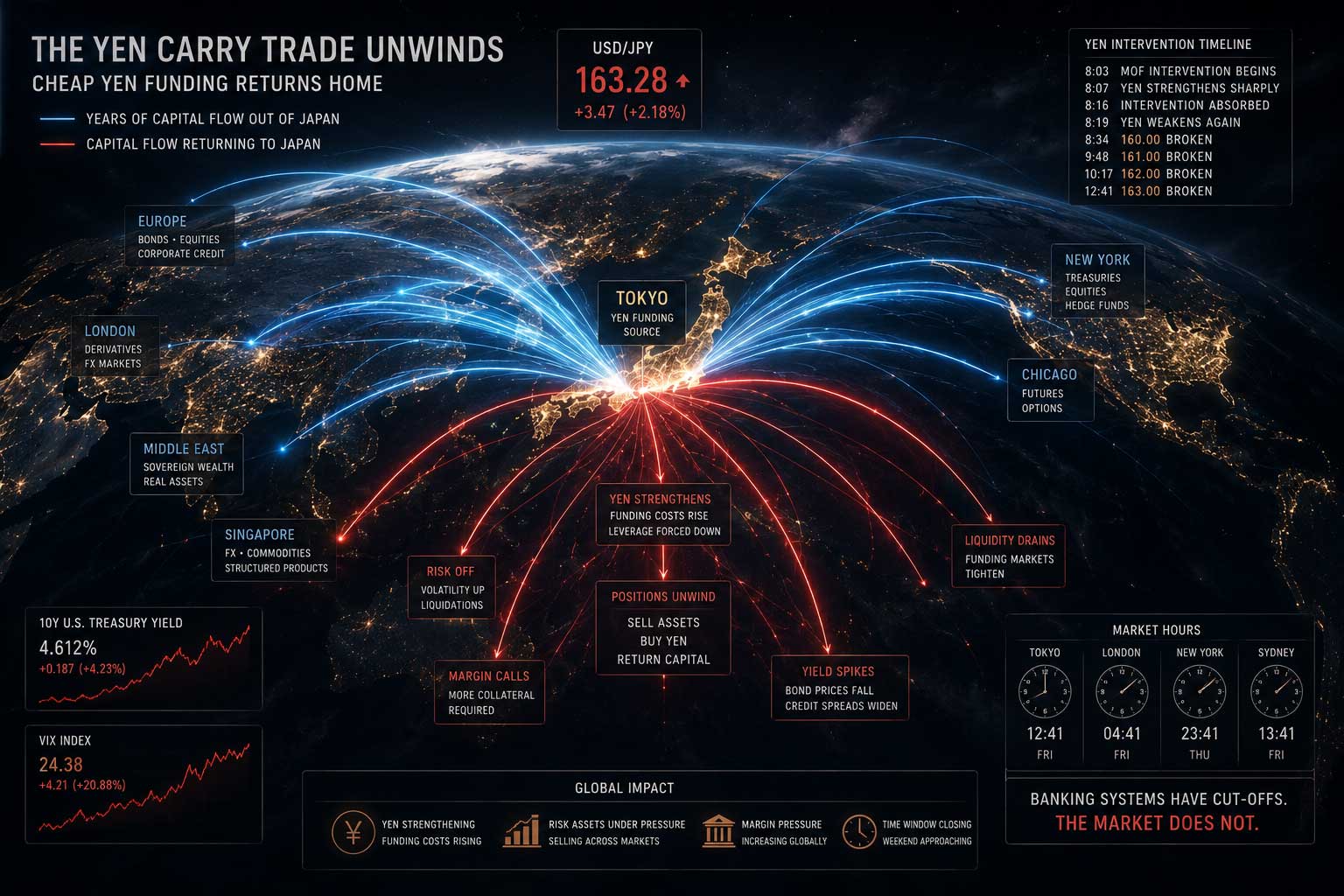
For years, the economics had been almost embarrassingly attractive. Borrow in Japan at comparatively low rates. Convert the yen. Buy higher-yielding assets somewhere else. U.S. Treasuries. Corporate credit. Equities. Structured products. Leveraged strategies.
The trade had many names and thousands of variations, but underneath them was the same proposition.
Cheap yen financed more expensive assets.
As long as the yen remained weak and Japanese funding remained cheap, the machinery worked.
But leverage contained a mathematical cruelty that disappeared during calm markets. When enough investors held variations of the same trade, they didn’t have to agree to exit it.
The market could make the decision for them.
Noa entered 162.00 into the stress model.
The system began recalculating Kiyomizu’s positions across thirty-seven banking relationships and six major custodians.
Sato was still on the telephone.
“How long?”
“Maybe ninety seconds.”
“Call me when it finishes.”
He disconnected.
Noa looked back at the central display.
160.44
Then, at 8:03, the number vanished.
For less than a second the currency panel was blank.
When it returned, the yen was at 158.91.
A murmur passed across the room.
Someone behind Noa said, “They’re in.”
There was no announcement from the Ministry of Finance. There never was at first. The market simply revealed the intervention through price.
158.47.
157.82.
157.36.
The yen was strengthening with extraordinary speed.
Across the room, one of the currency analysts raised his hand and traced an invisible line downward, as though directing an aircraft toward a runway.
Noa watched without speaking.
Billions of dollars were being converted into yen somewhere beyond her screen. Whether the orders originated in Tokyo, New York, or both would be argued about later. For the moment, the message was unmistakable.
The authorities had drawn a line.
The market retreated.
At 8:07 the yen reached 156.94.
Noa’s stress model finished.
A red figure appeared near the bottom of the screen.
She leaned forward.
The number wasn’t catastrophic.
It was considerably worse than yesterday.
She opened the underlying positions.
The problem wasn’t Kiyomizu’s currency hedge.
It was collateral.
A series of derivative agreements would require additional margin if volatility crossed specified thresholds. Several financing arrangements contained their own triggers. A large acquisition completed earlier in the year had introduced dollar obligations that were adequately hedged under ordinary conditions but depended upon liquidity moving between subsidiaries.
Individually, none of them concerned her.
Together, they did.
Her phone rang again.
Sato.
“How bad?”
“We can cover it.”
“That wasn’t my question.”
Noa looked at the screen.
“We have enough assets.”
“Also not my question.”
She knew what he wanted.
Noa opened the custody map.
New York.
London.
Singapore.
Frankfurt.
Tokyo.
Money everywhere.
She began looking at settlement windows.
Then banking holidays.
Then the calendar.
Monday was Labor Day in the United States.
She stared at it.
Friday in Tokyo was approaching Friday in Europe. New York would open later that evening, close, and enter a three-day weekend.
Some of the collateral could move.
Some could not.
Some could be pledged but not settled.
Some cash balances were available economically but inaccessible operationally without intermediary banks completing transfers across jurisdictions.
The company had liquidity.
What it did not necessarily have was mobile liquidity.
“I see it,” she said.
Sato didn’t answer immediately.
On the central display the intervention continued to work.
156.81.
156.73.
156.92.
Noa watched the last number.
Then another.
157.08.
157.21.
She sat upright.
The room had noticed it too.
The yen was weakening again.
At first slowly.
Then faster.
157.46.
157.88.
158.17.
The enormous intervention that had pushed the currency more than three yen in minutes was being absorbed by the market.
Noa had never seen that happen so quickly.
At 8:19, Sato spoke again.
His voice had changed.
“Now run the model at 165.”
Noa looked at the screen.
“That’s ridiculous.”
“Probably.”
She entered the number anyway.
165.00
The model began calculating.
Outside the windows, Tokyo had awakened completely. Trains moved through the city. Office towers filled. Delivery trucks crowded the streets below. Millions of people were beginning an ordinary Friday morning without any reason to know that, somewhere inside the machinery of global finance, one of the world’s largest funding trades was beginning to change direction.
Noa watched the yen cross 159.
The intervention had lasted sixteen minutes.
The market had taken it back in eleven.
Her terminal chimed.
The new collateral calculation was complete.
This time, the number was large enough that she read it twice.
Sato didn’t ask her what it said.
He already knew.
“Call New York,” he said.
“Who?”
“Everyone.”
ACT II — THE UNWIND
Tokyo Friday, September 4, 2026 9:26 A.M.
By nine-thirty, the intervention was no longer the story.
The story was what it had disturbed.
Noa had spent the previous hour on calls with Kiyomizu’s banks in Tokyo, Singapore and London, and the answers were reassuring in precisely the way she had learned to distrust. Credit lines remained available. Counterparties were functioning normally. No material settlement failures had been reported. The company’s liquidity position remained strong.
Every statement was technically correct.
Her screen suggested something else.
She opened a dashboard showing Kiyomizu’s collateral obligations by jurisdiction. The model projected the consequences of a yen at 165, but exchange rates were only one variable. Volatility had begun moving through derivatives portfolios, which changed margin requirements, which altered cash needs, which forced institutions to sell assets or pledge additional collateral.
That was how leverage traveled.
A portfolio manager in London didn’t have to own a Japanese stock or trade the yen to be exposed to what was happening in Tokyo. If his fund had borrowed yen to finance a leveraged position in U.S. credit, a strengthening yen increased the cost of repaying the loan. If the position moved against him at the same time, his prime broker could demand additional collateral. To meet the margin call, he might sell Treasuries.
The Treasury buyer on the other side might be in Chicago.
The funding bank might be in Tokyo.
The custodian holding the collateral might be in New York.
The problem could begin in Japan and materialize almost anywhere.
Noa’s phone displayed Sato’s name again.
“You were right,” she said.
“I’d prefer not to be.”
“Ten-year?”
“Watch it.”
She pulled up the U.S. Treasury market.
The move wasn’t dramatic. Not yet. But yields were climbing while bid-ask spreads widened across several maturities.
“Forced selling?”
“Some.”
“How much?”
“Nobody knows.”
Noa looked at the clock. “New York isn’t even open.”
“No,” Sato said. “But the positions are.”
That distinction stayed with her.
She opened another window containing market estimates of yen-funded carry positions. The numbers varied enormously because there was no single instrument called the carry trade. Some exposure existed in currency forwards, some in swaps, some through bank lending, some through leveraged funds, and much of it could never be identified precisely from public data.
What mattered was the direction.
For years, enormous quantities of cheap Japanese capital had migrated outward in search of yield.
Now some of it wanted to come home.
At 9:41, the yen crossed 160 again.
At 9:48, it reached 161.06.
Noa’s treasury system issued its first automated collateral warning.
USD 184,000,000
She examined the position.
A derivatives counterparty in London had increased an initial margin requirement.
The company could satisfy it easily.
She approved the transfer.
A second alert appeared six minutes later.
USD 327,000,000
Singapore.
Then another.
USD 91,000,000
New York.
She began moving balances.
The first transfer cleared.
The second required additional authorization.
The third encountered a cutoff issue at an intermediary institution.
Noa called the bank.
A man in Singapore explained the problem in language so polite that it took nearly a minute to establish that the money would not arrive when she needed it.
“What is the earliest value date?”
“Under normal processing, Monday.”
“Monday is a U.S. holiday.”
There was a pause.
“Then Tuesday.”
Noa looked at the collateral deadline.
“Tuesday isn’t useful.”
“I understand.”
“No. The margin call expires today.”
Another pause.
“I understand.”
She ended the call.
Kiyomizu had more than enough cash to satisfy the obligation.
Some of it was simply on the wrong side of the financial system.
At 10:17, Sato arrived in person.
He wore a charcoal suit that looked as though it had survived several previous crises with him. He declined coffee and stood behind Noa while she showed him the liquidity map.
Green represented immediately available cash.
Amber represented assets that could be monetized within twenty-four hours.
Red represented everything else.
The map had contained very little red the previous morning.
Now it was spreading.
“These aren’t losses,” Noa said.
“I know.”
“We own the assets.”
“I know.”
“The balance sheet is fine.”
Sato pulled a chair beside her.
“You’re still thinking about solvency.”
“I’m thinking about liquidity.”
“No. You’re thinking about how much liquidity you have.”
He pointed at the screen.
“You need to think about when you have it.”
Noa said nothing.
Sato enlarged the map.
“Finance has spent a century making capital global and then left the clocks local.”
He pointed toward New York.
“Your securities are there.”
Then London.
“Your derivatives are there.”
Singapore.
“Cash there.”
Tokyo.
“Obligations here.”
He leaned back.
“You have one balance sheet. The financial system sees four countries, six custodians, thirty-seven banking relationships and several different settlement calendars.”
Noa understood his point.
Kiyomizu’s assets were economically unified.
Operationally, they were fragmented.
Another alert appeared.
USD 412,000,000
Sato read it.
“Still comfortable?”
“Yes.”
“What if the yen reaches 165?”
“We’re covered.”
“One-seventy?”
Noa looked at him.
“That’s not happening.”
“Good.”
He stood.
“Run it.”
The 170 scenario changed the screen.
Not because Kiyomizu suddenly became insolvent.
It didn’t.
The company still possessed several times the assets necessary to meet the projected calls.
But the model began flagging settlement constraints faster than funding constraints.
One custodian required instructions before New York’s cutoff.
A European securities position could be sold, but cash settlement would lag the trade.
Several short-term investments were highly liquid during normal market hours but could not be converted instantly outside them.
Cash held by Asian subsidiaries could move regionally but would require correspondent banks to reach certain dollar accounts.
And every hour that passed brought the company closer to the American holiday weekend.
Noa stared at the results.
The risk wasn’t that they would run out of money.
The risk was that they would have billions of dollars and still miss a payment.
London
3:06 A.M. New York
The first large fund failed a margin call.
The name did not become public.
It didn’t need to.
Within minutes, prime brokers began reducing exposure to similar strategies. Risk limits tightened automatically. Haircuts increased on collateral that had been considered pristine the previous day.
The algorithms didn’t know it was Friday.
They didn’t know Monday was Labor Day.
They didn’t care.
They measured volatility, leverage and counterparty exposure.
Then they demanded more collateral.
By noon in Tokyo, selling had spread from currencies into equities and sovereign debt.
The yen reached 163.28.
U.S. Treasury yields climbed again.
Financial television began using the phrase carry-trade unwind.
Noa muted the broadcast.
She had work to do.
At 12:41, a message arrived from Kiyomizu’s New York treasury office.
Possible alternative liquidity facility available through prime broker. Digital settlement capability. 24/7. Reviewing eligibility.
Noa read it twice.
Then deleted the message from her priority queue.
They had banks.
They had credit facilities.
They had billions in liquid securities.
She wasn’t going to solve a multinational treasury problem with cryptocurrency.
Three minutes later another margin call appeared.
USD 618,000,000
This one required same-day settlement.
Noa reopened the message.
Sato noticed.
“What?”
“New York says they have another route.”
“Which bank?”
“It isn’t a bank.”
Sato waited.
Noa opened the attachment.
At the top of the document was a name she recognized from financial news but had never encountered inside one of Kiyomizu’s treasury systems.
RIPPLE PRIME
She looked farther down.
The facility covered institutional financing, collateral and cross-asset liquidity.
The counterparty relationship had been established months earlier by Kiyomizu’s North American treasury group.
Noa frowned.
“Why do we have an account with Ripple?”
Sato moved beside her.
He read the document.
Then he looked at the collateral deadline.
“Apparently,” he said, “because somebody thought we might need it.”
Outside the windows, Tokyo continued through an ordinary Friday afternoon.
Inside the treasury system, another clock had started counting down.

New York Friday, September 4, 2026 9:11 A.M.
ACT III - PRIME BROKER
Daniel Mercer had been watching Japan for six hours.
By the time he reached the office, the overnight team had already compiled the exposure report: yen volatility, Treasury liquidation, margin utilization, collateral concentrations, counterparty limits and the first indications of stress among leveraged funds. The document was eighty-seven pages long.
Mercer read three.
The rest was available if he needed it.
He had spent most of his career in prime brokerage, first at a European bank and later at Hidden Road, where he learned that financial crises were rarely caused by the thing everyone was watching on television. The visible event attracted attention because it was easy to understand. The dangerous event usually occurred somewhere behind it, where leverage connected markets that appeared unrelated.
Today everyone was watching the yen.
Mercer was watching collateral.
His office overlooked lower Manhattan, although he had barely looked through the windows since arriving. On the wall opposite his desk, a display summarized client activity across foreign exchange, fixed income, derivatives, digital assets and financing.
Red indicators were multiplying.
Not failures.
Demands.
More margin.
More financing.
More collateral substitutions.
More requests to move assets between venues.
A message appeared from the risk desk.
Japan-linked macro fund requesting collateral substitution. $740M.
Another followed.
Treasury financing utilization +18% since Asia open.
Then:
USD/JPY liquidity deteriorating across primary venues.
Mercer opened the depth chart.
The yen still traded everywhere. That wasn’t the problem.
The price of immediacy was increasing.
At 9:17, his deputy stepped into the office.
“New York Treasury desk says we’re getting corporate requests now.”
“How many?”
“Eleven since eight.”
“Normal day?”
“Maybe two.”
Mercer turned toward him.
“Funds?”
“Three macro. Two multi-strat. One market maker is asking about increasing financing.”
“Keep them inside limits.”
“We are.”
“What about corporates?”
“Mostly collateral mobility. One Japanese industrial client is asking about the digital facility.”
Mercer looked back at his screen.
“Kiyomizu?”
“Yes.”
He knew the name.
Large Japanese industrial conglomerate. Conservative treasury operation. Extensive dollar requirements. The kind of company that could spend two years approving a new financial counterparty and then barely use it.
Hidden Road had established the relationship before the Ripple integration was complete.
“What do they need?”
“Six-eighteen same day. Possibly more.”
“Collateral?”
“Initially.”
“Eligible assets?”
“Plenty.”
“Then what’s the problem?”
His deputy gave him the answer Mercer expected.
“Location.”
Mercer nodded.
The oldest problem in global finance.
Money in the wrong place.
The name Ripple Prime still attracted more attention outside institutional markets than inside them.
To Mercer, that was useful.
Hidden Road had been built as a multi-asset prime broker, providing institutions with access to markets, financing, clearing and other services that ordinarily required relationships across multiple large intermediaries. Ripple’s acquisition had changed the ownership and expanded the infrastructure, but it hadn’t changed the fundamental nature of Mercer’s work.
Clients still needed financing.
Trades still needed clearing.
Collateral still had to be managed.
Counterparties still had to trust one another.
Risk still had to be priced.
The difference was that Ripple had connected the prime brokerage business to capabilities Hidden Road had never possessed on its own.
Payments.
Institutional custody.
Stablecoin infrastructure.
Treasury management.
Blockchain settlement.
The integration had happened gradually enough that most clients barely noticed it.
That was intentional.
Nobody running a billion-dollar portfolio wanted a revolution.
They wanted lower financing costs and fewer operational problems.
At 9:32, Mercer entered the main operations room.
A large screen showed global collateral utilization. Another displayed settlement obligations by currency. A third tracked digital markets.
The smallest screen in the room showed XRP.
Mercer barely looked at it.
“How much digital settlement today?” he asked.
A woman at the liquidity desk checked.
“Across Prime?”
“Everything.”
She gave him the figure.
It was higher than yesterday.
Still insignificant compared with the traditional side of the business.
Mercer wasn’t surprised.
Months earlier, Ripple’s chief executive, Brad Garlinghouse, had publicly described the scale of activity passing through the company’s expanding infrastructure. The number had attracted enormous attention in crypto circles.
Sixteen trillion dollars of payments or clearing activity.
The part most people ignored was what Garlinghouse said next.
Almost none of it had gone through digital assets.
Mercer had thought that was the more interesting number.
Zero was not evidence that digital settlement had failed.
It was evidence of how much traditional financial activity already existed on infrastructure that could increasingly interact with it.
There was no requirement that the percentage become ten.
Or five.
Or even one.
At sixteen trillion dollars, very small percentages stopped being small numbers.
At 9:46, the Federal Reserve Bank of New York opened normally.
Treasury markets did not.
Prices moved violently during the first twenty minutes. Dealers widened spreads. Several large asset managers sold intermediate maturities, while other institutions bought aggressively into the weakness.
Liquidity existed.
But it was becoming expensive.
Mercer’s system flagged another collateral request.
Then another.
The important change occurred at 10:03.
A large client offered tokenized U.S. Treasury securities as collateral.
The request itself wasn’t unusual anymore. Tokenized government debt had become increasingly common within institutional digital markets as banks, asset managers and financial infrastructure providers experimented with representing traditional securities on blockchain networks.
The unusual part was the time horizon.
Settlement required: Saturday.
Mercer looked at the request.
The underlying Treasury market would close that afternoon.
The token would not.
That distinction was beginning to matter.
Tokyo
11:08 P.M.
Noa had been awake for nineteen hours.
The treasury floor had emptied and filled twice as shifts changed, although she had never left her desk. Dinner arrived in a cardboard container sometime after eight and remained unopened beside her keyboard.
The yen was at 164.11.
Kiyomizu had satisfied every margin call so far.
That should have reassured her.
Instead, the remaining liquidity map bothered her more each time she opened it.
The company had mobilized the easiest assets first.
Cash.
Committed credit.
Immediately transferable securities.
What remained was increasingly constrained by geography, settlement schedules or operational procedures.
New York would close soon.
Then the weekend began.
Noa opened the Ripple Prime document again.
She had spent several hours examining the relationship.
It was legitimate.
More than legitimate.
Kiyomizu’s American treasury team had completed institutional onboarding months earlier as part of a broader digital-liquidity initiative approved by the board. The facility could access traditional and digital markets through the same prime brokerage relationship.
That last part interested her.
She initiated a call.
Mercer appeared on screen forty seconds later.
He looked irritatingly rested.
“Ms. Tanaka.”
“Mr. Mercer.”
“I understand you have a collateral problem.”
“We have a settlement problem.”
Mercer smiled slightly.
“That’s usually more interesting.”
Noa didn’t.
“We have sufficient assets.”
“I’ve seen the balance sheet.”
“We need six hundred eighteen million dollars against the London position.”
“Today?”
“Today.”
“We can do that.”
“Through which bank?”
“That depends on which route you choose.”
“I want the normal route.”
“So would I.”
That answer surprised her.
Mercer turned one of his screens toward the camera.
“Your normal route requires two intermediaries after New York cutoff. Earliest confirmed settlement is Tuesday.”
“I know.”
“The digital route doesn’t.”
Noa folded her arms.
“You’re proposing cryptocurrency.”
“No.”
“What are you proposing?”
“I’m proposing settlement.”
He enlarged a diagram.
On one side were Kiyomizu’s eligible assets.
On the other was the dollar obligation.
Between them were several possible routes.
Some were conventional.
Some weren’t.
“Your mistake,” Mercer said, “is treating digital assets as an asset class.”
“Aren’t they?”
“Sometimes. That’s not what we’re discussing.”
He selected one route.
“We’re discussing infrastructure.”
Noa examined the screen.
The first leg involved tokenized short-term government securities already held within one of Kiyomizu’s approved custody arrangements.
The second involved dollar liquidity.
A name appeared beside it.
RLUSD
Noa recognized that too.
“A stablecoin.”
“A dollar instrument.”
“That’s a convenient distinction.”
“It’s an important one.”
“To Ripple.”
“To your accountant.”
Noa almost smiled.
Mercer continued.
“One dollar in. One dollar represented digitally. One dollar redeemable through the issuer’s infrastructure. You don’t need to speculate on anything.”
“And XRP?”
“Not required.”
Noa looked at him.
She hadn’t expected that answer.
“I thought that was the point.”
“The point is completing your transaction.”
He returned to the routing screen.
“If the cheapest reliable route uses dollars, we use dollars. If it uses RLUSD, we use RLUSD. If another network gives us better execution, we evaluate that.”
“Another network?”
“We’re a prime broker, Ms. Tanaka. We’re not a religion.”
For the first time that day, Noa laughed.
Mercer didn’t.
“The question isn’t which technology you believe in.”
His screen displayed the deadline.
02:00 UTC
“The question is which infrastructure will still be operating when you need your money.”
Noa looked at the clock.
New York had less than six hours before the long weekend.
Tokyo was already approaching Saturday.
“Send me the route.”
“I already did.”
Her terminal chimed.
A file appeared.
Noa opened it.
The structure was considerably more complicated than Mercer had made it sound.
Custody.
Tokenized collateral.
Stablecoin liquidity.
Traditional banking.
Blockchain settlement.
Several systems she recognized.
Several she didn’t.
And one fact she understood immediately.
There was no Monday column.
The system operated continuously.
Noa looked back at Mercer.
“What happens when the banks close?”
“Some routes disappear.”
“And yours?”
Mercer leaned back.
“That’s when ours becomes interesting.”
New York Friday, September 4, 2026 3:37 P.M.
ACT IV — THE WEEKEND
Twenty-three minutes before the Treasury market closed, Daniel Mercer watched liquidity disappear.
It did not disappear completely. Markets rarely behaved that cleanly. Instead, bids became smaller, spreads became wider, and prices that had been available for hundreds of millions of dollars were suddenly available for fifty.
Then twenty.
Then five.
The distinction mattered if you were trading five million dollars.
It mattered considerably more if you were trying to move five hundred million.
Ripple Prime’s operations room had been running at full capacity since the New York open. Mercer had postponed two meetings, cancelled a third, and eaten half a sandwich while standing behind the financing desk.
The yen traded at 164.72.
More important to Mercer, the number of intraday margin calls across Prime’s institutional client base had nearly tripled.
“How much Treasury collateral is still pending?” he asked.
“One-point-eight billion conventional,” an analyst answered. “Another six-twenty tokenized.”
“Settlement?”
“Conventional depends on custodian.”
“And tokenized?”
“Available.”
Mercer checked the clock.
That single word summarized the problem.
Available.
The underlying assets were nearly identical.
The clocks governing them were not.
At 4:00 P.M., the U.S. Treasury cash market closed.
At 4:01, the financial obligations created during the day remained exactly where they had been.
The global economy did not stop because a bell had rung in New York.
Factories continued producing goods.
Aircraft crossed borders.
Power plants consumed fuel.
Derivatives continued changing value.
Automated risk systems recalculated collateral requirements.
Cryptocurrency markets traded.
Foreign-exchange venues continued operating elsewhere.
Somewhere in Asia, Saturday had already begun.
The traditional financial system had not failed.
It had done precisely what it was designed to do.
It had reached the end of its business day.
Tokyo
Saturday, September 5, 2026
5:18 A.M.
Noa woke at her desk.
For several seconds she did not know where she was.
The treasury floor was dark except for workstation displays and the lights of Tokyo beyond the windows. Someone had placed a folded jacket beneath her head.
Sato sat six desks away reading a report.
“You snore,” he said.
“I don’t.”
“You do during currency crises.”
Noa looked at the clock.
She had slept forty-seven minutes.
Then she looked at the yen.
165.38
She was awake.
“What happened?”
“New York closed.”
“I can see that.”
“Another fund gated redemptions.”
“Which one?”
“Doesn’t matter yet.”
“It will.”
“Eventually.”
Noa opened Kiyomizu’s liquidity dashboard.
The company’s position was still sound.
That had become almost irrelevant.
Three new collateral requests had arrived while she slept.
The largest was for $284 million.
The deadline was Saturday afternoon.
She stared at it.
“Who asks for collateral on Saturday?”
Sato looked over his glasses.
“Someone who wants to be paid on Saturday.”
She began checking available routes.
The company’s primary banks displayed the same frustrating pattern.
Funds available.
Instructions accepted.
Settlement pending.
Value date delayed.
Intermediary unavailable.
Manual review required.
Weekend processing.
Monday holiday.
Tuesday.
Tuesday.
Tuesday.
Noa leaned back.
“How can a company have eleven billion dollars of liquid assets and struggle to move two hundred eighty-four million?”
Sato closed his report.
“Because ‘liquid’ is a word economists use when the banks are open.”
At 5:42, Noa opened the route Mercer had sent.
It was still active.
Prices had changed.
Availability had not.
The tokenized Treasury collateral remained eligible.
Digital dollar liquidity remained available.
The custody system was operating.
Settlement was available.
She opened a chat window.
TANAKA: Is this live?
Mercer’s reply arrived twelve seconds later.
MERCER: Yes.
TANAKA: It’s 4:43 PM Friday in New York.
MERCER: I’m familiar with clocks.
TANAKA: When does the facility close?
There was a longer pause.
MERCER: It doesn’t.
Noa stared at the words.
She spent the next hour trying to prove him wrong.
The first system she examined was Ripple Treasury.
Kiyomizu’s North American division had begun integrating the platform after Ripple acquired GTreasury, a treasury-management company whose history predated blockchain by decades. The combination initially struck Noa as strange: conventional corporate treasury software sitting beside stablecoins, digital custody and blockchain settlement.
Now she understood the logic.
The system did not create liquidity.
It revealed it.
Cash accounts.
Short-term investments.
Tokenized assets.
Credit facilities.
Digital-dollar balances.
Custody positions.
Instead of viewing them through separate institutional systems, the treasury team could see them as parts of the same liquidity picture.
That solved the first problem.
Where was the money?
The second problem was harder.
How did they move it?
The route passed through infrastructure Ripple had assembled over several years.
Noa began opening the corporate histories.
Metaco.
Institutional digital-asset custody technology.
Standard Custody.
Regulated custody infrastructure.
Palisade.
Wallet and custody capabilities designed for high-speed institutional movement.
Rail.
Stablecoin payments infrastructure.
GTreasury.
Corporate treasury management.
Hidden Road.
Prime brokerage.
Noa looked at the acquisition dates.
At first they appeared unrelated.
Custody company.
Payments company.
Treasury software.
Prime broker.
Wallet infrastructure.
Then she stopped reading them chronologically and arranged them according to the transaction in front of her.
The picture changed.
Find the capital.
Treasury.
Secure the asset.
Custody.
Access markets and financing.
Prime brokerage.
Move digital dollars.
Payments.
Settle the transaction.
Blockchain.
She stared at the sequence.
Ripple had not been buying companies in the same industry.
It had been buying different parts of the same transaction.
At 6:31 A.M., Mercer called.
Noa accepted.
“You’ve been researching us.”
“Your acquisitions.”
“That’s worse.”
“Why?”
“People who research acquisitions eventually build diagrams.”
“I built one.”
Mercer sighed.
Noa shared it.
“Am I wrong?”
“Not exactly.”
“That’s evasive.”
“It’s incomplete.”
“What am I missing?”
“The networks.”
Noa looked at him.
“XRPL?”
“Among others.”
He opened a market view.
The screen showed assets and liquidity distributed across several digital environments.
Some Noa recognized.
Ethereum.
XRP Ledger.
Stellar.
Others came from the institutional side of tokenized finance.
Canton.
Hedera.
Private bank networks.
Traditional custody systems connected through APIs and interoperability layers.
“Your diagram assumes digital finance becomes one network,” Mercer said. “It won’t.”
“Then what’s the advantage?”
“Same advantage the internet had.”
“Which is?”
“The networks don’t have to be identical. They have to communicate.”
He selected one tokenized security.
“This asset is available through one environment.”
Then a payment route.
“This counterparty operates through another.”
A custody account appeared.
“Your asset is here.”
A dollar obligation appeared somewhere else.
“And your problem is there.”
Noa understood where he was going.
“We’re back where we started.”
“Exactly.”
“Money in the wrong place.”
“Digital finance doesn’t eliminate that problem.”
“Then what does it solve?”
Mercer changed the display.
Multiple possible routes appeared between the assets.
“More ways to solve it.”
Washington
Friday evening
Television screens across the treasury floor showed lawmakers discussing digital-asset market structure.
Noa had muted them hours earlier.
The debate continued anyway.
Commodity.
Security.
Jurisdiction.
Disclosure.
Market structure.
Consumer protection.
The terminology had dominated Washington for years.
Sato watched for several minutes.
“Important?” he asked.
“Probably.”
“For tonight?”
“No.”
He nodded.
That was the end of the conversation.
Whatever Congress eventually decided, Kiyomizu already possessed legally established relationships with banks, custodians, brokers and regulated financial entities.
The obligation on Noa’s screen existed now.
Its deadline did not care about legislation.
Tokyo
Saturday, September 5, 2026
8:54 A.M.
Kiyomizu authorized the first digital collateral transfer.
Noa expected something dramatic.
There was nothing to see.
An authorization request appeared.
Two executives approved it.
Custody controls verified the instruction.
The tokenized Treasury position moved.
A settlement confirmation arrived.
USD 284,000,000
Elapsed time:
4.8 seconds
Noa checked it again.
The underlying economic value had moved from an asset Kiyomizu owned to collateral recognized by the receiving institution.
On Saturday.
She turned toward Sato.
“That’s it?”
“What were you expecting?”
“I don’t know.”
“Music?”
She ignored him.
The transaction had not used XRP.
It had not needed XRP.
It had solved a collateral problem using tokenized securities and digital settlement.
That fact interested Noa more than if somebody had forced a cryptocurrency into the transaction.
The system had selected the appropriate tool.
She looked at the liquidity dashboard.
For the first time since Friday morning, one of the red indicators disappeared.
Then Mercer’s name appeared on her screen.
CALL — PRIORITY
Noa answered.
His expression told her the problem had changed again.
“What happened?”
“The yen.”
She looked.
167.14
“What about it?”
“Direct dollar-yen liquidity is deteriorating.”
“We have dollar liquidity.”
“I know.”
“Then convert it.”
“At what price?”
Mercer sent her the market depth.
Noa opened it.
The spread was enormous.
She assumed the feed was wrong.
“It isn’t wrong,” Mercer said.
“That’s impossible.”
“It was impossible yesterday.”
Noa looked at the available bids.
For small transactions, the market still functioned.
For the size Kiyomizu now required, the price deteriorated rapidly.
“How much do we need?”
“Your projected requirement?”
“Yes.”
Mercer entered the number.
USD 1,140,000,000
Noa exhaled.
“Can you do it?”
“Yes.”
“Direct?”
“No.”
“What route?”
“We’re calculating.”
Across Mercer’s screen, liquidity engines began evaluating markets that Noa had never considered part of the same transaction.
Banks.
FX venues.
Stablecoins.
Digital exchanges.
Institutional pools.
Multiple blockchain networks.
For several seconds neither spoke.
Then one route moved to the top.
Noa recognized the symbol immediately.
XRP
She looked at Mercer.
“You said we didn’t need it.”
“We didn’t.”
“And now?”
Mercer studied the execution model.
“Now it may be cheaper.”
Noa stared at the screen.
That was the moment she finally understood what he had been trying to explain.
XRP was not waiting at the center of every transaction.
It was waiting among the possible routes.
And for the first time that weekend, the market was beginning to choose it.
ACT V — THE OTHER RAIL
Tokyo Saturday, September 5, 2026 9:12 A.M.
Noa had expected the XRP route to be complicated.
It wasn’t.
The complication was everything around it.
Ripple Prime’s execution system displayed eleven possible paths for Kiyomizu’s projected $1.14 billion requirement. Each route connected the same starting point and destination: dollar liquidity on one side, yen on the other.
What changed was the path between them.
The first route used conventional foreign exchange.
The second divided the order among several bank and non-bank liquidity providers.
Three routes used stablecoins.
Another combined tokenized collateral with an institutional FX venue.
Several crossed digital markets.
One briefly used XRP.
Noa opened the conventional route.
The quoted price looked reasonable.
Then she expanded the market depth.
It wasn’t.
The first $50 million could be executed near the displayed rate. The next hundred million moved the price. Beyond that, available liquidity deteriorated quickly. By the time the full order was modeled, the effective cost had become difficult to justify.
“Why is it showing a market that doesn’t exist?” she asked.
Mercer was still connected from New York.
“It exists.”
“Not for a billion dollars.”
“Exactly.”
Noa switched to the XRP route.
The execution engine divided the transaction across multiple liquidity pools and venues. Dollar liquidity entered from several sources, including RLUSD. XRP appeared only in the middle of the route. On the destination side, the system sourced yen through available institutional counterparties and digital markets.
Noa enlarged the diagram.
“How long do we hold XRP?”
“You don’t.”
“Kiyomizu has to own it at some point.”
“For several seconds, economically.”
“That’s ownership.”
“If you’d like to put it on the balance sheet for four seconds, I’m sure your accounting department would enjoy the meeting.”
She ignored him.
“What happens if XRP drops five percent during settlement?”
“We price that risk.”
“And if liquidity disappears?”
“The route changes.”
“Automatically?”
“Within approved parameters.”
Noa looked at the eleven alternatives.
“So the system could select XRP now and something else ten minutes later.”
“Of course.”
“Then why would XRP matter?”
Mercer leaned closer to the camera.
“Because right now two markets need to exchange value and the direct bridge between them is expensive.”
He highlighted the middle of the route.
“XRP is another bridge.”
Noa had spent years thinking about currencies in pairs.
Dollar-yen.
Euro-dollar.
Sterling-yen.
Each pair represented a market with its own participants, spreads and liquidity.
The problem became obvious when she imagined the same structure multiplied across thousands of assets.
Currencies.
Stablecoins.
Tokenized bonds.
Money-market funds.
Commodities.
Digital securities.
Private credit.
Different blockchain networks.
Different jurisdictions.
Different settlement systems.
If every asset required a deep direct market against every other asset, the amount of capital required to maintain those markets would become enormous.
A bridge asset changed the geometry.
Asset A did not necessarily require a deep market directly against Asset B if both could access a sufficiently liquid intermediary.
Noa looked again at XRP.
For the first time, she stopped thinking of it as a cryptocurrency someone wanted her company to buy.
She thought of it as a routing asset.
That was considerably less exciting.
It was also considerably more useful.
New York
Friday, September 4, 2026
8:27 P.M.
Mercer’s operations room had thinned but not emptied.
The traditional desks had reduced staffing after market close.
The digital side was getting busier.
That inversion had become increasingly common during weekends, although Mercer had never seen it occur at this scale.
A client in Europe was moving tokenized collateral through Canton-connected infrastructure.
A payments company was sourcing dollar liquidity through Stellar-based rails.
An enterprise treasury transaction involved assets represented through Hedera.
Several Ethereum markets were supplying stablecoin liquidity.
XRPL activity had increased sharply.
None of this surprised Mercer.
The popular discussion around blockchain still tended to imagine a future in which one network won and the others disappeared.
Institutional finance was developing in the opposite direction.
Banks did not use one database.
Markets did not use one messaging network.
Corporations did not use one cloud provider.
There was little reason to believe tokenized finance would consolidate onto one ledger.
The real opportunity belonged to systems capable of moving value between them.
Interoperability solved part of that problem.
Liquidity solved the rest.
At 8:41, a warning appeared.
USD/JPY DIRECT DEPTH -31%
Mercer opened the Kiyomizu route again.
XRP remained first.
But the margin was narrowing.
Another stablecoin route had improved.
He watched the models update.
For several seconds the stablecoin route moved into first position.
Then a large order consumed part of its available yen liquidity.
XRP returned to the top.
This was how Mercer wanted the system to behave.
No loyalty.
No narrative.
Price.
Depth.
Settlement probability.
Counterparty exposure.
Execution cost.
Time.
The asset that won the calculation got the transaction.
Tokyo
Saturday, September 5, 2026
10:03 A.M.
Sato stood behind Noa watching the route evaluation.
“You trust this?”
“No.”
“Good.”
She looked at him.
“You don’t?”
“I don’t trust anything involving a billion dollars.”
Noa returned to the screen.
The projected requirement had risen again.
USD 1.37 billion
The yen was at 168.02.
“Have you ever used XRP?” she asked.
Sato shook his head.
“Bitcoin?”
“No.”
“Stablecoins?”
“No.”
“Then why aren’t you objecting?”
“Because I used correspondent banks in 1998.”
Noa waited.
Sato pulled a chair beside her.
“When I was your age, moving money internationally meant accepting that money disappeared into a chain of institutions for a while. Your bank knew where it sent the instruction. The receiving bank knew when it arrived. Between them were correspondent accounts, reconciliation systems, cutoffs and people calling other people.”
“Nostro accounts.”
“Yes.”
Kiyomizu maintained them indirectly through its banking relationships: pools of money positioned around the world so institutions could satisfy obligations without waiting for funds to travel internationally each time.
Reliable.
Expensive.
And dependent upon predicting where liquidity would be needed.
“Global banking solved distance by putting money everywhere in advance,” Sato said.
Noa looked at the digital routing screen.
“And this?”
“Maybe it solves distance by moving the money.”
At 10:18, Kiyomizu authorized a test transaction.
Not $1.37 billion.
$25 million.
Mercer insisted.
“If it fails,” he said, “I want a twenty-five-million-dollar problem.”
Noa approved the instruction.
Dollar liquidity entered the route.
Part arrived as RLUSD.
The execution engine acquired XRP across approved liquidity venues.
Noa watched the position appear.
XRP EXPOSURE
For an instant, Kiyomizu Industrial Group economically controlled several million units of an asset Noa had dismissed less than twelve hours earlier.
The number fluctuated.
Then disappeared.
Yen arrived at the destination.
Noa looked at the timer.
3.7 seconds
“Again,” she said.
The second transaction was $50 million.
4.1 seconds
The third was $100 million.
The execution cost remained inside tolerance.
Mercer spoke through the conference line.
“Depth is holding.”
Noa checked the conventional FX route.
It had deteriorated further.
“How much can you move?”
“That’s the wrong question.”
“Why?”
“Because if we announce a billion-dollar order to the market, the market will charge us for announcing it.”
“What do you suggest?”
“Execution slices. Multiple venues. Continuous route evaluation.”
“And if XRP stops being cheapest?”
“We stop using XRP.”
Noa approved the strategy.
The next thirty-seven minutes were among the least dramatic of her career.
There were no alarms.
Nobody shouted.
No television anchor announced that the global financial system had changed.
Transactions simply completed.
$75 million.
$120 million.
$90 million.
Some used XRP.
One used a stablecoin route.
Another crossed conventional liquidity when a bank quote briefly improved.
Then XRP again.
The execution engine treated the distinction as irrelevant.
Noa increasingly did too.
What mattered was that yen kept arriving.
At 10:57, the cumulative figure crossed one billion dollars.
Sato was standing at the windows.
Noa called him over.
“Look.”
He examined the transaction history.
Multiple assets.
Multiple venues.
Multiple networks.
One destination.
“How much XRP do we own?” he asked.
Noa checked.
“None.”
“How much did we use?”
She opened the execution report.
A very large number appeared.
Sato smiled.
“Interesting.”
That was the distinction.
Ownership was not the same as utility.
Kiyomizu had not accumulated XRP.
It had consumed its liquidity.
At 11:14, Mercer’s screen displayed another change.
Not Kiyomizu.
Prime-wide.
Digital settlement volume was accelerating across the institutional client base.
Tokenized Treasury collateral.
Stablecoin transfers.
Digital FX routes.
Cross-network transactions.
XRP bridge liquidity.
For years, most of the enormous activity passing through Ripple’s expanding institutional infrastructure had remained traditional.
That morning, the percentage was changing.
Still small.
But no longer close to zero.
Mercer watched the figure update.
He didn’t call anyone.
He didn’t need to.
The market was doing the experiment for them.
Tokyo
Saturday, September 5, 2026
11:32 A.M.
Noa received confirmation that Kiyomizu’s immediate yen requirement had been satisfied.
She should have felt relief.
Instead, she was looking at another number.
Ripple Prime’s routing engine showed the cost difference between conventional and digitally sourced liquidity during the previous hour.
She ran the comparison twice.
Then she opened a new model.
Not a crisis model.
A normal operating model.
“What are you doing?” Sato asked.
“Checking something.”
“The margin call is covered.”
“I know.”
“Then go home.”
Noa continued typing.
She changed USD/JPY volatility to normal.
Restored conventional market depth.
Removed the weekend constraint.
Reduced collateral pressure.
Then she ran the routes again.
Traditional FX returned to first place.
XRP dropped down the list.
Noa smiled.
Sato looked over her shoulder.
“Bad news?”
“No.”
“Then why are you smiling?”
“Because it isn’t magic.”
He waited.
“It only wins when it’s useful.”
Sato considered that.
“Most good infrastructure does.”
ACT VI — THE SETTLEMENT
Tokyo Saturday, September 5, 2026 1:46 P.M.
By early afternoon, Kiyomizu’s immediate liquidity problem had become larger and easier to solve.
The contradiction was not lost on Noa.
At eight that morning, every new collateral request had forced her to ask where the company could find the money. Six hours later, the treasury system displayed more than enough accessible liquidity to satisfy the remaining obligations.
The assets had not changed.
Their mobility had.
Noa reviewed the transaction history.
Tokenized Treasury collateral had satisfied three margin calls.
RLUSD had provided dollar liquidity for two international obligations.
Traditional bank liquidity had handled several transactions where conventional markets remained competitive.
XRP had bridged portions of the dollar-yen requirement when direct FX depth deteriorated.
Other routes had been evaluated and rejected.
The system had not migrated onto a blockchain.
It had learned to use several.
That distinction mattered.
At 1:53, another request arrived.
Noa opened it expecting another margin call.
It wasn’t.
Kiyomizu’s European energy subsidiary had a large payment obligation associated with a grid-infrastructure acquisition completed earlier in the year. Under ordinary circumstances the treasury team would have funded it Monday morning through the company’s European banking relationships.
The counterparty had changed the terms.
Additional collateral required before Asian markets reopen Monday.
Amount:
USD equivalent: $2.81 billion
Noa stared at it.
Sato walked over.
“Problem?”
“Large one.”
He read the request.
“Can we cover it?”
Noa almost answered automatically.
Then stopped.
That question had changed meaning during the previous twenty-four hours.
“We own enough assets.”
Sato smiled.
“Better.”
“I don’t know whether we can move enough.”
“Even better.”
She called Mercer.
New York
Saturday, September 5, 2026
1:04 A.M.
Mercer answered from home.
He was wearing a T-shirt.
Noa found this more disturbing than the currency crisis.
“You’re not at the office.”
“It’s Saturday.”
“Your entire argument is that Saturday doesn’t matter.”
“My argument is that the infrastructure works on Saturday. I never said I wanted to.”
She sent him the obligation.
Mercer’s expression changed.
“Two-eight-one?”
“Yes.”
“Deadline?”
“Before Tokyo Monday.”
“Assets?”
Noa sent the inventory.
Mercer opened it.
Kiyomizu held short-duration government securities, dollar deposits, tokenized Treasury positions, money-market instruments and several pools of available cash.
Enough value.
Again, the problem was configuration.
“Give me twenty minutes,” he said.
The proposed structure arrived in seventeen.
Noa opened it.
This time she understood most of the components.
A portion of Kiyomizu’s tokenized Treasury holdings would move directly as collateral.
Another block of conventional securities would support financing through Ripple Prime.
Dollar liquidity would be assembled from multiple sources.
RLUSD would handle part of the digital-dollar leg.
The destination required several currencies, so the execution engine would continuously evaluate available FX routes.
Some would settle conventionally.
Some would use stablecoin liquidity.
XRP remained approved as an intermediary where the routing engine determined that it reduced execution cost or improved settlement probability.
Custody controls would remain distributed across Kiyomizu’s approved institutional arrangements.
No single network handled the entire transaction.
No single asset did either.
Noa studied the structure.
“This is messy.”
Mercer was back on the call.
“Finance is messy.”
“I thought blockchain was supposed to simplify everything.”
“That’s something people who don’t work in finance say.”
“What does it simplify?”
“Settlement.”
He highlighted the final column.
Every route terminated in the same place.
DELIVERED
At 2:22 P.M., Kiyomizu’s chief financial officer authorized the transaction.
Noa provided the second approval.
The first collateral block moved.
$410 million
Confirmed.
A financing leg followed.
$600 million
Confirmed.
Dollar liquidity entered from two sources.
Part converted directly into euros.
Another portion remained in RLUSD until destination liquidity became available.
The routing engine continuously recalculated the yen and euro markets.
For several minutes XRP did not appear at all.
Then a large order struck one of the direct currency venues.
Depth fell.
The routing engine changed.
XRP BRIDGE — ACTIVE
Noa watched the transaction.
Dollar liquidity converted.
XRP appeared.
Three seconds later it disappeared.
Destination currency arrived.
The route changed again.
Stablecoin.
Then direct FX.
Then XRP.
Noa stopped trying to anticipate it.
That was the point.
At 2:48, Mercer sent a message.
$1.9B COMPLETE
Noa acknowledged it.
At 2:56:
$2.3B
Then:
$2.61B
The final portion was the most difficult.
A European counterparty required settlement into an account whose banking infrastructure would not recognize the digital collateral directly.
The money could reach the institution’s digital custodian.
It could not reach the final account.
Noa stared at the routing diagram.
After everything they had done, the last obstacle was a conventional bank account.
Mercer called.
“We need a bridge back.”
“XRP?”
“No.”
“What then?”
“A bank.”
Noa laughed.
Mercer did too.
For twenty-three minutes, Ripple Prime’s operations team worked through an available correspondent relationship in Asia whose weekend window remained open.
The final digital position was converted.
The bank accepted the funds.
The receiving institution confirmed them.
Noa watched the final status change.
SETTLED
She looked at the timestamp.
3:21:08 P.M. JST
The total obligation had been satisfied.
$2.81 billion
Noa opened the conventional settlement estimate generated when the request first arrived.
Expected completion: Tuesday, September 8
She placed the two records beside each other.
Tuesday.
Saturday.
Nothing else on the screen seemed important.
Sato had been standing at the windows again.
Tokyo was bright beneath them.
People filled the streets around Marunouchi. Restaurants were open. Trains ran. Tourists moved through the station carrying shopping bags.
Nobody outside the building knew what had just happened.
Noa walked over.
“Finished.”
“All of it?”
“Two-point-eight-one billion.”
“When?”
“Now.”
Sato looked at his watch.
“Saturday.”
“Yes.”
He nodded.
No celebration.
No astonishment.
No declaration that the banking system had become obsolete.
He simply looked back across the city.
“What would the old route have done?”
“Tuesday.”
Sato considered the difference.
“Three days.”
“Approximately.”
“No.”
He turned toward her.
“Three days is the wrong measurement.”
Noa waited.
“The difference was that one system had stopped.”
He pointed toward her terminal.
“And the other had not.”
New York
Saturday, September 5, 2026
2:31 A.M.
Mercer closed the Kiyomizu file.
The transaction summary showed every instrument used.
Bank deposits.
Government securities.
Tokenized Treasuries.
Prime financing.
RLUSD.
Traditional foreign exchange.
Digital liquidity venues.
XRP.
Correspondent banking.
Eight categories of infrastructure had participated in a transaction that commentators would inevitably try to describe as either traditional finance or digital finance.
Mercer considered the distinction meaningless.
It was finance.
He opened the Prime-wide activity report.
The number had continued climbing.
Digital settlement remained a minority of total activity.
A small minority.
But compared with the percentages Ripple’s leadership had discussed publicly months earlier, the change was unmistakable.
The infrastructure had not been waiting for permission.
It had been waiting for demand.
Mercer closed the report.
Another request appeared.
He opened it.
Tokyo
Saturday, September 5, 2026
3:29 P.M.
Noa returned to her desk.
The yen was trading at 167.61.
The crisis was not over.
Markets would open again.
Central banks would respond.
Politicians would speak.
Economists would argue about intervention, interest rates, Treasury holdings and the future of the carry trade.
There would be investigations into failed funds.
There would be congressional hearings.
There would be people claiming digital assets had saved the financial system.
There would be others insisting they had done nothing important.
Both would be wrong.
Noa looked at the completed transaction.
The digital infrastructure had not saved the financial system.
It had solved a problem.
That seemed more significant.
She opened the transaction details and searched for XRP.
The total amount routed through it during the weekend was enormous.
Kiyomizu’s ending XRP balance remained:
0
Noa looked at the number for several seconds.
Then she understood why Mercer had never cared whether she believed in it.
The asset had done its job.
It had moved value.
It did not need to stay.
This story is fiction. The infrastructure behind it is not. Prime brokerage, institutional custody, tokenized assets, stablecoins, blockchain settlement and digital liquidity networks are being assembled today, while traditional finance continues operating alongside them. Whether the catalyst is a currency crisis, a liquidity shock, or something far less dramatic, the transition may not arrive with an announcement or a single moment when someone “flips the switch.” It may happen transaction by transaction, whenever an institution asks the most practical question in finance: Which route can move the value safely, efficiently—and right now? The system that provides the best answer will not need to replace everything that came before it. It will simply be used.
